By Simon Carr, Abi Hackett, Kate Pahl, Samiya Ambreen, Khawla Badwan, Elizabeth Curtis, Susannah Gill, Ambika Kapoor, Peter Lawrence, Johan Siebers, and Jan White
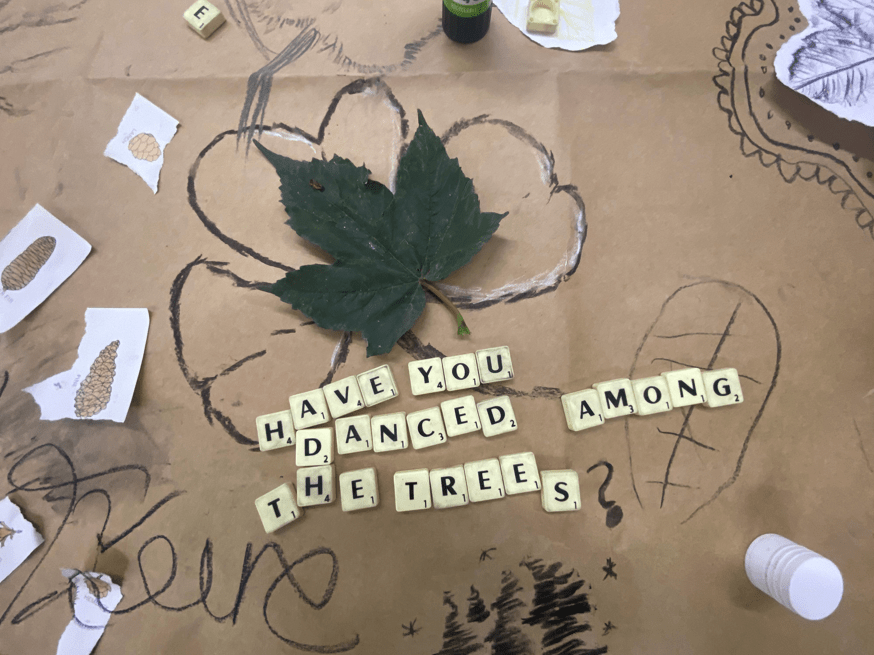
Children and young people will be the witnesses and judges of the decisions we make today. Among our decisions are those about enhancing treescapes in our towns and cities. Yet in the UK, most urban environmental planning decisions offer only a token opportunity for decisionmakers to hear the voices of young people. Typically, environmental planning sub-consciously considers all children to be a uniform, generic group whose opinions will be similar to those of adults. Given that children and young people are typically far more engaged with environmental and climate change issues, planning’s lack of understanding about and engagement with young people is a key challenge.
Our research offers insights into how we can move away from traditional surveys and questionnaires towards methods that better ‘listen’ to the voices of children and young people. As a team of environmental, social science, humanities and arts researchers, alongside organisations that plant trees in urban settings, we worked with children and young people to create activities that explored their relationships with trees. And we listened to their dreams and hopes of how their local communities might look in the future.
We found that children and young people’s views and ways of valuing treescapes are complex, reflecting rich and sophisticated relationships between themselves and trees, operating at individual to global scales, even within the youngest children. We identify six principles to guide best practice in working with children and young people in environmental decision making. These principles attune to the diversity of children and young people’s views, offers opportunity to build understanding through exploration and curiosity, and recognising the significance of often tiny moments. Most importantly, our approach moves away from an adult-centric decision making towards one that values the voices of children in a way that is hopeful about the future. We find that our approach yields improved tree survival rates, and greater connection between local communities and urban treescapes.
 Relational Thinking