By Sarah B. Gutzmann, Charles Humchitt, Kevin Kowalchuk, Dorothy Hunt, Alyssa Allchurch, Andrés Cisneros-Montemayor, and Anne K. Salomon
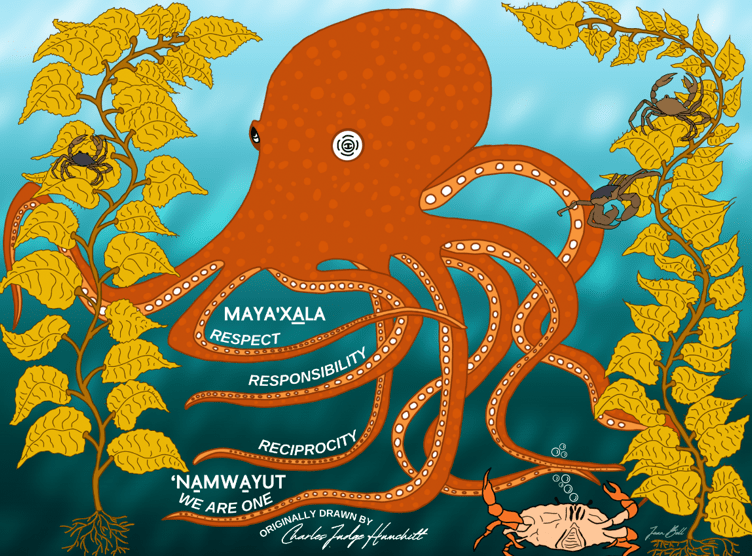
Among the Kwakiutl, an Indigenous community on the west coast of Canada, the ancestral governance principles of maya’xala (respect), reciprocity, namwayut (we are one), and responsibility must guide kelp harvest and farming (kelps are a group of seaweed). In fact, community members valued the availability of kelp, as part of a healthy ocean, for future generations more than the economic value of kelp as a commercial product. While kelp farming jobs and associated income interested people, they more highly valued the long-term persistence of flourishing kelp forests and human-kelp relationships. Lastly, Kwakiutl decision-makers identified that future kelp management must encourage knowledge sharing among community members, active stewardship of kelps, as well as capacity building to support climate resilient kelp harvest and farming.
Locally, our collaborative research will help guide Kwakiutl decision makers as they decide if, how much, and where to harvest and farm kelp in their territory. Globally, our results highlight that ocean economies and policies must reflect local community interests and have local benefits if they are to be equitable and just.
 Relational Thinking