By Raphaella Mascia, Alison Smith, Martha Crockatt, and Yadvinder Malhi.
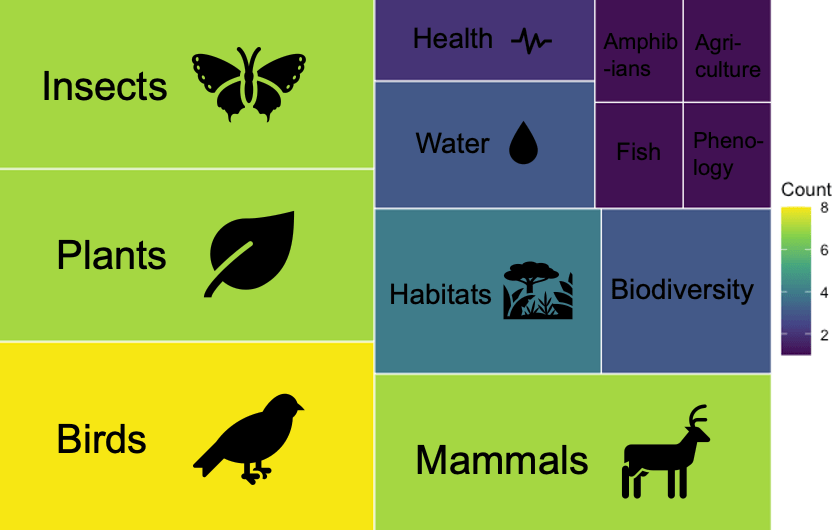
Nature provides people with numerous benefits that support and sustain our well-being. Such benefits have been measured so that we can manage and improve the ecosystems that support them. However, such assessments of nature’s benefits are limited often by multiple factors like a lack of quality data, resources, and expertise. To address these challenges, new approaches have been proposed to expand how we evaluate nature’s benefits—including community science, the practice of involving the public in scientific research. Our study explored how existing community science can contribute to assessing nature’s benefits. Using the United Kingdom as a case study, we applied a mixed methods approach that combined a systematic review of community science programmes with a survey of community scientists.
We found that while few programmes or participants directly measure nature’s benefits, many collect data that are indirectly associated with them. The most common benefit measured through UK community science was biodiversity, which underpins many other benefits such as clean air, food, and recreation. Many programmes also gathered data connected to multiple benefits. However, we identified clear gaps in community science for assessing cultural, aquatic, and soil-related benefits. Survey participants supported expanding the role of community science in assessing nature’s benefits but raised concerns about data quality and emphasised that community science should be viewed as a complementary tool, rather than the only method for assessment.
Our findings reveal a significant opportunity to expand community science to help fill gaps in evaluating nature’s benefits on multiple geographic levels. Yet, realising this potential will require action including adapting or creating programmes that address underrepresented benefits, increasing government and funding support for community science, and integrating community science into environmental policy and guidance. By doing so, we can build a more inclusive and data-rich understanding of how nature supports and sustains people and communities.
 Relational Thinking