By Thirze Hermans, Julia Hartman, Sander van den Burg, Bertram de Rooij, and Peter Verweij.
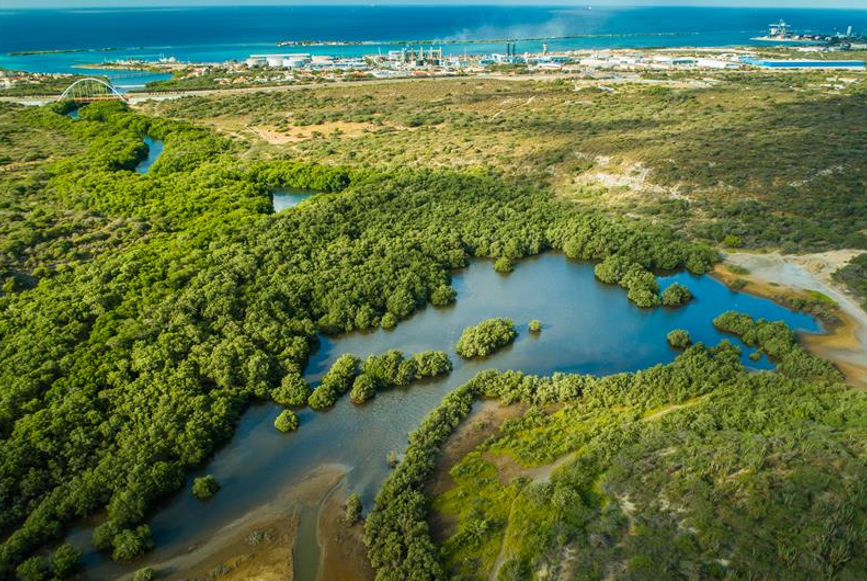
Stopping biodiversity loss and climate change requires big, systemic changes in how societies function. Finding the key areas (“leverage points”) where action can trigger this dramatic change is difficult because systems are complex, uncertain, and involve many different perspectives. We wanted to understand more about how to identify leverage points for building a nature-inclusive future. To do so, we studied Bonaire and Aruba, two small islands facing environmental and social challenges. We also tested whether the method of backcasting (working backwards from a desired future to figure out the steps needed to reach that future) is useful in this process.
We identified four main leverage points:
• Fair and effective governance;
• Nature-inclusive infrastructure;
• Shifting economy;
• Connecting nature with cultural identity;
However, immediate social and economic pressures, along with issues like land ownership and weak enforcement, often block long-term solutions. Economic dependence on a few sectors, a declining connection between people and nature, and challenges in land use and infrastructure, are shared concerns on both islands. The study found two types of tools (“levers”) that can drive change: Hard levers, such as enforcement, regulation, and incentives, and soft levers, such as education, culture, knowledge sharing, and capacity building.
Backcasting as a method proved useful, though demanding in time and facilitation. When done carefully and with a focus on specific themes, it helps produce more practical and actionable results. Overall, the findings highlight both the barriers and opportunities for transformative change on small tropical islands. They also show how backcasting can deepen understanding of pathways toward a nature-inclusive future in complex, resource-limited settings.
 Relational Thinking