By Isabell A. Österle, Sofie Paulus, Arne Schwietering, Volker Audorff, and Manuel J. Steinbauer
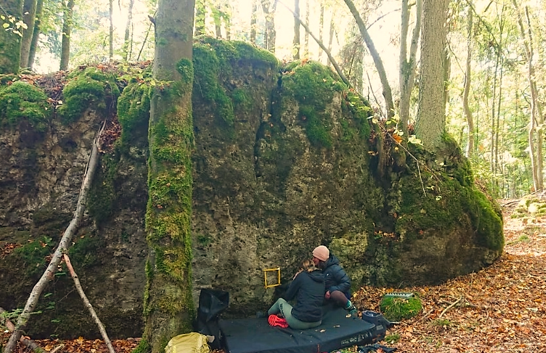
With the growing popularity of rock climbing, the pressure on rock ecosystems is increasing. To reconcile nature conservation and recreational use, it is therefore important to better understand the impact of climbing on these sensitive habitats.
For this purpose, we climbed three previously unclimbed rocks 500 times, and we did so without cleaning the routes prior to climbing them, meaning no vegetation or soil was removed from the holds beforehand. These small rocks, known as boulders, were composed of sandstone, limestone and granite. During the ascents, photos of the selected hand and footholds were taken at fixed intervals to record the unintentional removal (%) of rock vegetation and enable visual assessment. During the 500 ascents, there was a total vegetation loss of 0-15% points on the climbing holds, with the most significant changes occurring during the first ascents. The extent of damage to the vegetation varied depending on the rock type: soft sandstone was particularly vulnerable, likely due to physical wear of the rock surface. However, since only one boulder per rock type was studied, the findings may not be representative for other cliff ecosystems, even within the same rock type.
We also observed the regeneration of a cliff ecosystem after climbing. Using sandstone as an example, we were able to show that the rock’s microbial community had partially recovered three years after climbing. In addition, it was determined that black discoloration visible on a limestone hold was caused by microplastics from climbing shoes, which was proven using a special light analysis (Raman spectroscopy). This suggests that climbing may contribute to plastic pollution in natural environments.
These results show that climbing, especially the first ascents, can cause long-lasting damage to rock vegetation. Protecting these sensitive ecosystems requires well-defined development guidelines for new routes and climbing areas as well as clear restrictions on vegetation removal, especially regarding rare, specialized and endemic species. Therefore, we recommend zoning concepts for sensitive areas, where compromises between climbing and conservation are developed.
This study aims to support climbers, ecologists, and local authorities in working together to find solutions that reduce the environmental impact of climbing.
 Relational Thinking