By Miguel A. Cebrián-Piqueras, Konrad Gray, Lukas Kuhn, Jacqueline Loos, Ioana A. Patru-Duse, Maraja Riechers, Vicky Temperton and Berta Martín-López
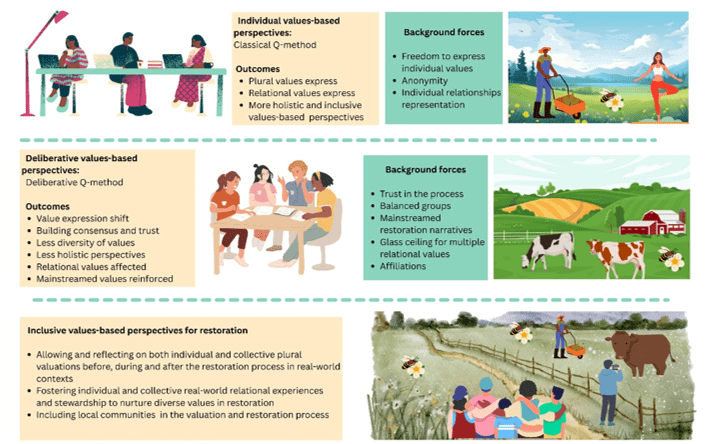
Deciding which values of nature should guide restoration goals and how these values are negotiated can define the restoration projects. Our study aimed to evaluate the differences and similarities between individually and deliberatively elicited values and related perspectives towards grasslands to inform restoration efforts. Additionally, it sought to assess how group deliberation and associated factors influence shifts in value expressions and associated perspectives. Shifts in value expression are possibly related to the elicitation framing and methods used, as well as the institutional contexts in which valuation is embedded. Our results indicate that relational values referring to moral principles towards nature (e.g., stewardship and care) or grounded in the traditions of nature conservation in cultural landscapes (e.g., aesthetics) are expressed well through both individual and deliberative valuation methods, possibly because the institutional setting of conservation in cultural landscapes supports them. However, those relational values representing the relationships between individuals and grasslands are overlooked in deliberative approaches because these values are, by nature, very personal, nuanced, and tied to specific contexts (e.g., a sense of place).
Our results show that, despite the importance of certain relational values (i.e., cultural identity, sense of place, therapeutic, and relaxation) at the individual level, they encounter a “glass ceiling” in the collective discourse. This barrier might be reinforced by the additive effects of affiliations, representation, institutional context, and mainstreamed values in conservation policies, which may be more salient during group deliberations compared to individual-based elicitation. Participatory and transdisciplinary decision-making processes should pay particular attention to allow the expression of neglected and dormant values, and clearly reflect on the outcomes of elicitation methods to better accommodate interventions that amplify the voices of marginalised groups and local communities in the decision-making process of restoration interventions.
We argue that the mainstream legacies of biodiversity conservation, which frame “nature for itself” (intrinsic values) and “nature for people” (instrumental values), might play a significant role in collectively defining the importance of grasslands and their restoration. Despite the momentum for a “relational turn” in the academic arena and the calls to articulate relational values in conservation and social-ecological restoration, relational values are still neglected in biodiversity conservation and restoration. Based on these results, we call for the application of complementary and plural valuation methods, including both deliberative and individual elicitation approaches, as collective deliberation processes alone might jeopardise the expression of an individual’s particular relationship with nature in favour of the common good. Furthermore, these results suggest the need for greater inclusion of local communities in participatory processes, which may encompass multiple relational values not considered here. We argue that value-based restoration participatory processes should (i) consider plural valuations of nature and related reflections before, during and after the co-designed interventions, (ii) foster collective and individual real-world relational experiences and stewardship to nurture diverse values of nature, and (iii) include and empower local communities.
 Relational Thinking