By Alexandru Sabin Bădărău, Mihai Pop, Imola Püsök, Dacinia Crina Petrescu, Ruxandra Malina Petrescu-Mag, Cristian Maloș, Kinga Réti, László Csákány, László Rákosy, Till Wagener, Noémi Antal, Viorel Arghiuș, Mihaela Spac, Andreea Nita, Frank Wagener, Laura Bouriaud, and Tibor Hartel
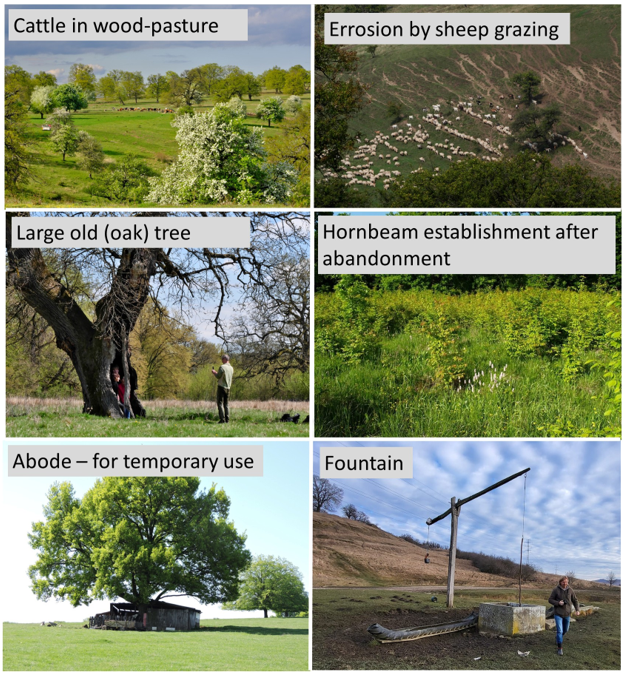
By biocultural values we mean both the visible features and the lived practices of wood-pastures (e.g. trees, fences, grazing signs, local rules, and daily work). We want to explore how people express, maintain, or erode biocultural values in traditional wood-pastures of Transylvania. We used the Stephenson’s Cultural Values Model (CVM), which includes three pillars: (1) ‘Forms,’ referring to the material and visible elements of the landscape (such as scattered ancient trees, tree groups, elements of traditional or modern land-use infrastructure); (2) ‘Practices,’ referring to the current land-use activities that shape and sustain the landscape (such as grazing, pruning); and (3) ‘Relationships,’ reflecting the emotional, cultural, and intergenerational ties people hold toward these places.
We employed this framework to guide both data collection and analysis across a sample of over 100 wood-pastures, spanning gradients of accessibility, land cover, and local governance. Our fieldwork included detailed ecological inventories, land-use observations, and semi-structured interviews with local residents. By integrating quantitative and qualitative data through the CVM lens, we examined how biocultural elements vary spatially and socially.
Our results show that traditional Forms and Practices occur more often in rugged, forest-adjacent wood-pastures with low accessibility, whereas more accessible sites more frequently exhibit modern structures and practices. At the same time, traditional and modern elements often co-exist, forming hybrid configurations. Interview evidence points to a weakening of community-based stewardship and a shift toward bureaucratic or mechanized management, suggesting an emerging decoupling between on-the-ground features and lived cultural relationships
We conclude that while some visual and functional aspects of biocultural systems persist, the cultural relationships that historically ensured their care are eroding. Conservation and rural development strategies must go beyond preserving physical features to also engage with the local communities to revive the stewardship forms which can assure the persistence of wood-pastures.
 Relational Thinking