By Elena Andriollo, Elena Pisani, Mauro Masiero, Tommaso Sitzia, and Thomas Campagnaro
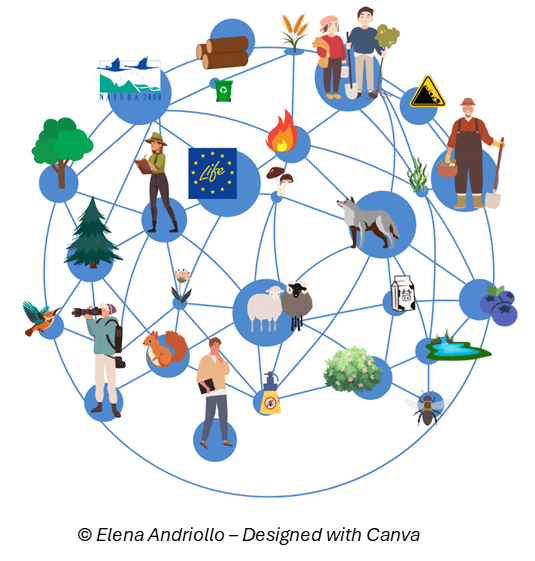
In biodiversity conservation, understanding the relationship between social and ecological systems is crucial. This concept, known as “social-ecological fit,” is particularly important in the management of protected areas.
The LIFE Programme, is the most important EU funding instrument for environmental and climate action. This study explored human-nature relationships by examining how the LIFE Programme integrates with the management of Natura 2000 protected areas, focusing particularly on forest habitat types. By using Social Network Analysis, the study investigated the connections between LIFE projects, beneficiaries, and habitat types. It analysed 85 LIFE projects involving 373 beneficiaries, which targeted 141 habitat types across 801 Natura 2000 sites. This comprehensive approach provided information on the complex interactions within these conservation efforts.
The findings revealed both challenges and opportunities. The study identified significant fragmentation within project partnerships, which could lead to spatial misalignments in conservation efforts. However, it also found that LIFE projects operate across a diverse range of European landscapes, demonstrating an awareness of ecosystem dynamics and successional processes. These results show the need to focus more on social processes within LIFE projects. Addressing issues related to project coordination, coherence, and social equity could improve the long-term sustainability and effectiveness of these conservation efforts.
A key contribution of this study is the introduction of a reproducible and resource-efficient method for assessing biodiversity conservation projects. Using network analysis aligned with global frameworks, it offers a valuable tool for conservation managers and policy makers to evaluate and improve their approaches. This innovative method not only offers a comprehensive view of complex social-ecological interactions but also enables more informed decision-making in biodiversity management. Its adaptability across various contexts makes it particularly valuable for addressing the diverse challenges faced in conservation efforts worldwide.
 Relational Thinking