By Oscar Robert Jones, Lanydjana Munuŋgurr, Yanbatji Munuŋgurr, Thomas Marrkula, Brendan Wunuŋmurra, Yirralka Rangers, Lindsay Hutley, Kirstie Fryirs, and Emilie Ens.
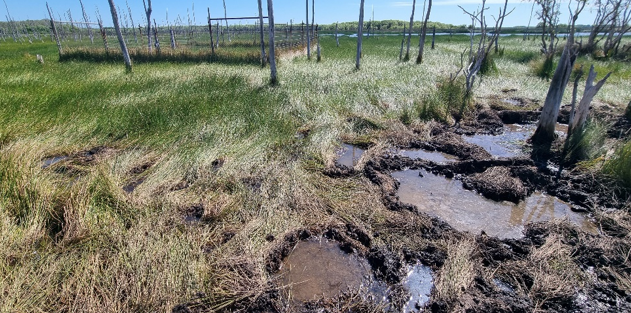
Photo: May 2023, Emilie Ens
The coastal floodplains of northern Australia remain relatively intact. However, they face growing threats from non-native hoofed mammals (called “ungulates”), such as the water buffalo (Bubalis bubalis) and wild pigs (Sus scrofa) that have been introduced to these ecosystems. Additionally, like other coastal areas across the globe, saltwater intrusion, where saltwater infiltrates freshwater coastal ecosystems, is also threatening vulnerable vegetation.
Policy makers, university researchers, and on-ground Indigenous organisations have proposed carbon-market incentives to control introduced ungulates to support effective management and protect these ecosystems from further degradation. Unfortunately, however, there has been limited research on how these threats affect the health of floodplain forests situated in the region, and species of importance to local Yolŋu people. The Yolŋu Yirralka Rangers, the Gurrumuru Homeland community, and Western scientists conducted a collaborative study to investigate the impacts of introduced ungulates and saltwater intrusion through qualitative and quantitative methods near Gurrumuru Homeland in the Laynhapuy Indigenous Protected Area in Australia.
Through interviews, three Dhirramu (men) rangers suggested that introduced ungulates impacted bush food and vegetation on the floodplain, and enhanced saltwater intrusion, which further impacted culturally important areas, carbon stocks, and ultimately, Yolŋu wellbeing. In addition, traditional räkay (Eleocharis dulcis) bush food harvest and discussion with miyalk (women) revealed ungulate impacts on räkay corm abundance, size, and the soil they were found in, with some indication that salinity may have also affected corm size.
To complement the Yolŋu knowledge, we studied räkay corm characteristics, forest structure, and aboveground carbon stocks using a 5-year ungulate exclusion plot experiment. This Western scientific assessment suggested that saltwater intrusion was significantly affecting aboveground carbon stocks by degrading Melaleuca forests, while feral ungulates mainly reduced the understorey vegetation. In the räkay sedgeland, pigs heavily reduced räkay corms density, echoing the miyalk observations.
Whilst financial incentives to control introduced ungulates may offer a viable method to manage these species in northern Australia, decision-makers must also account for the interactive effects of saltwater intrusion. The cross-cultural approach of this project provided complementary and different insights that would not have been possible if either method had been used alone. This collaborative research suggested that social, cultural, ecological, and economic benefits could occur from new market-based incentives to manage introduced ungulates, if local values and cultural knowledge are embedded.
 Relational Thinking