By Zhuo Cheng, Xiaoping Lu, Yanxiao Fan, Qingjiang Cui, Xian Hu, and Chunlin Long
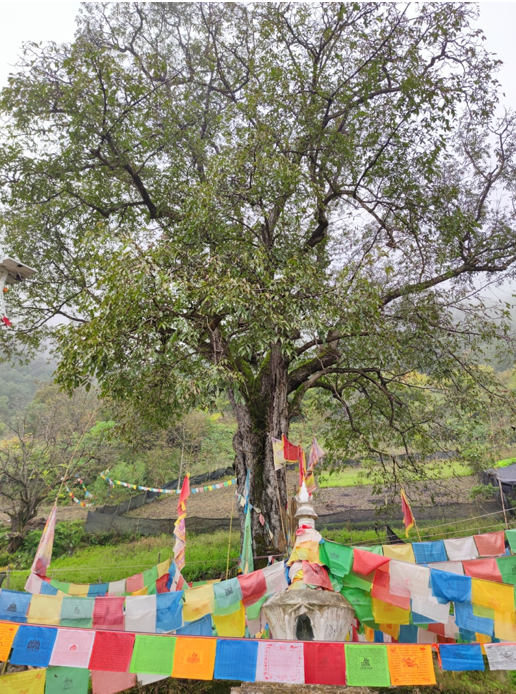
Large old trees are important ecological entities in human settlements and can provide ecological services and cultural values. The loss of large old trees could have profound ecological and cultural consequences. In recent years, the conservation of large old trees and their ecological and socio-cultural values has attracted the attention of scientists, policy makers and forestry practitioners. A key step in protection of large old trees is combining biological and cultural aspects to slow down the rate of large old trees decline and making a comprehensive understanding of large old trees protection mechanism.
We conducted an ethnobotanical survey of large old trees in the areas of China with the richest biocultural diversity, and quantified four environmental variables and three response variables to perform a generalized additive analysis. We found that local people possess a wealth of traditional knowledge related to large old trees. 95% of the large old trees have use value in the edible, medicinal, timber, ornamental, and cultural aspect, playing an important role in the local people’s life. Particularly, the proportion of cultural trees decreases with the increase of the proportion of Han population.
Our research found that traditional knowledge and local ethnic culture play an important role in the conservation of large old trees. In the future, it is necessary to integrate cultural dimension (taboos, Cunguiminyue and customary laws) in the protection of ancient and valuable trees.
 Relational Thinking