By Enora Bruley, Ignacio Palomo, Sandra Lavorel, Bruno Locatelli, and Titouan Dubo
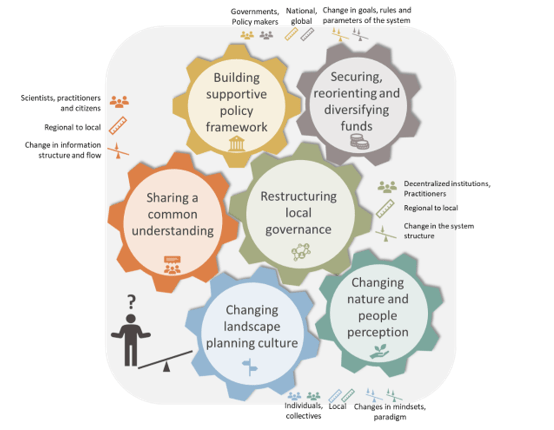
As the impacts of climate change intensify, Nature-based Solutions (NbS) are gaining recognition as promising strategies. NbS leverage natural ecological processes, through activities such as forest restoration or urban greening, to help societies adapt. However, despite a growing number of NbS initiatives, they often remain fragmented and insufficient to meet the scale of climate challenges. Our research explores the changes needed in current decision-making contexts to enable the widespread and effective implementation of NbS for climate adaptation.
Our study centred on the Grenoble region in the French Alps, which exemplifies an area facing multiple climate pressures. We analysed existing adaptation plans and policies, conducted interviews, and facilitated workshops with local experts, decision-makers and NbS practitioners. Our approach allowed workshops participants to collaboratively reflect on the current decision context, envision future possibilities, and systematically explore transformative changes essential for NbS scaling.
Our findings reveal that NbS scaling requires coordinated progress across multiple interconnected leverage points. These include establishing supportive policies and targeted funding; enhancing the production and sharing of knowledge about NbS; reforming local governance to strengthen collaboration; promoting a landscape planning culture that fully integrates nature; and encouraging shifts in societal values and perceptions of nature.
A key insight from our research is the critical role of deep leverage points, those that involve transforming core societal values, cultural norms, and our relationship with nature. Participants emphasized that without shifts in how we value nature, perceive risks, and engage in collaboration, efforts to scale NbS are unlikely to succeed. Yet, people largely overlook these deep leverage points in current adaptation policies, strategies and actions. We propose an integrative, systemic approach to help practitioners navigate complex decision contexts, create enabling conditions for scaling NbS, and ultimately support more effective and transformative adaptation efforts.
 Relational Thinking