By Felix Vusumuzi Skhosana, Nicola Stevens, Malebajoa Anicia Maoela, Sally Archibald and Guy F. Midgley.
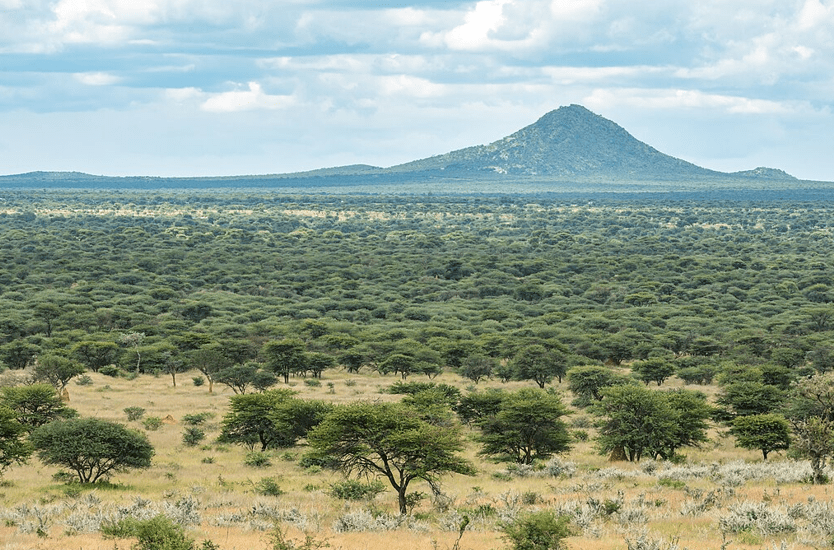
Woody encroachment is a phenomenon whereby shrubs and trees spread into grasslands as depicted by the image below taken in Namibia.
This increase in woody cover is changing how nature benefits people in North America and Africa. Our research reviewed existing studies to understand these impacts, focusing on material resources (nature’s physical substances we can use), non-material benefits (nature’s effects that enrich our lives), and regulating services (things nature does to support the environment). The key findings were that under material resources in both continents, woody encroachment reduces grass availability leading to a reduction in grazing animals and products such as meat and milk. On the other hand, woody encroachment also provides woody fuels and building material, which are important for local communities.
Under non-material benefits, woody encroachment negatively affects social activities and recreational activities that contribute to tourism, especially in Africa where these are significant for culture and income. Under regulating services woody encroachment affects water resources negatively and reduces habitats for various species in both continents. On the positive side, more trees means more carbon stored, which helps combat climate change globally. Despite these benefits, the negative impacts on vital resources like livestock forage and water in these dry systems are significant. These negative impacts are more severe in Africa, where people rely heavily on natural resources for their livelihoods.
To conclude, in this review we show that while woody encroachment might help with global issues such as carbon storage, it negatively affects other crucial local needs such as livestock, water and tourism. Therefore, as resource needs continue to increase due to population growth, there is a serious need for understanding these trade-offs. We also recommend future studies to also include the local or indigenous people’s perspectives in order to come up with a conclusive analysis of these issues and offer proper guidance in addressing this phenomenon of woody encroachment.
 Relational Thinking