By Claire Collins, Sam Weber, Lucy Clarke, Matthew Gollock, Nigel E. Hussey, Dan Simpson, Tiffany Simpson and David Curnick.
Negative interactions between humans and wildlife can lead to conflict, commonly termed “Human Wildlife Conflict” (HWC). However, physical interactions are not the only drivers of HWC as it is often caused by deeper social issues like differing views on wildlife, existing social inequity and feelings of injustice. There is a growing understanding of HWC and its drivers within a terrestrial context however, this issue remains under-researched for marine systems.
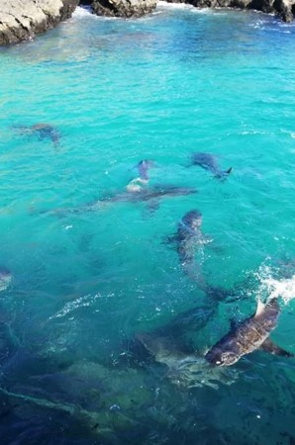
In this study, we focused on Ascension Island, a small, remote island in the Atlantic Ocean with around 800 residents, mostly British and St Helenian contractors. It became a no-take Marine Protected Area (MPA) in 2017, meaning only recreational fishing is allowed. Over the past 10 years, reports of shark-human interactions (SHIs) have grown, including two shark attacks in 2017 and sharks repeatedly taking fish in recreational fisheries.
To understand the situation, we spoke with community members through informal interviews. We then analysed this interview data to explore (a) how much conflict exists and, (b) what’s causing it. We found hidden psychosocial impacts including stress and anxiety from attacks, and that people had changed the way they live and use the ocean due to fear of attack. Many people felt that the number of sharks and their behaviours weren’t normal for the island, and some felt human actions drove these changes, meaning people were involuntarily exposed to heightened risk. There were also differing opinions on appropriate management of the situation. These drove deeper, underlying conflict, which can often be harder understand and solve.
We emphasise that understanding marine HWC needs a different approach to land-based HWC, as people often have less access to information and feel more uncertain about marine wildlife. Further, if we want to halt the rapid declines in shark populations globally through protection and management, then we need to find better ways to understand and manage these kinds of interactions.
 Relational Thinking