By Vincent Oostvogels, Raimon Ripoll-Bosch, Lucie Allart, Rebecca Etienne, Hanneke Nijland, Imke de Boer, and Bertrand Dumont.
Sixty interviews revealed both overlap and differences between the Netherlands and the French Massif Central in the stories – or ‘narratives’ – that dairy farmers use to talk about the relationship between their way of farming and biodiversity.
From both a social justice and conservation effectiveness perspective, it is vital that biodiversity initiatives in agriculture take into account how farmers understand and value their relationships with nature. However, in Europe – which is highly diverse in environmental conditions and farming practices – it remains largely unclear whether and how these views differ between regions.
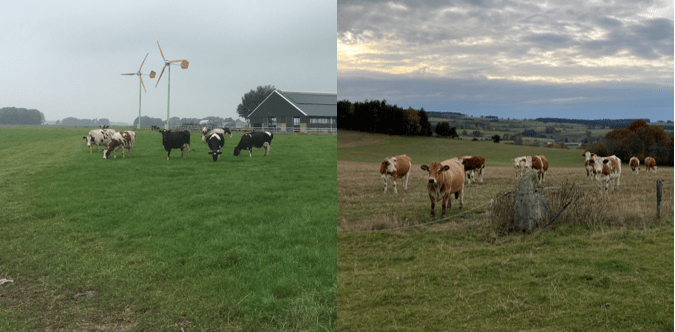
Therefore, we interviewed dairy farmers in two areas in the Netherlands and two in the French Massif Central about the relationship between their way of farming and biodiversity. We asked them about the impacts of their farm on biodiversity and vice versa, as well as the relational importance of biodiversity to them. We allowed farmers to use the term ‘biodiversity’ in their own words. We analysed the interviews using the Integrated Nature Futures Framework (I-NFF), a recently proposed valuation framework.
Six narratives emerged. We named these: ‘farming WITH biodiversity’, ‘farming FROM biodiversity – valorising what is there’, ‘farming FROM biodiversity – innovating for sustainability’, ‘farming FOR biodiversity’, ‘farming SEPARATE from biodiversity – out of necessity’, and ‘farming SEPARATE from biodiversity – out of conviction’. They differ in what farmers mean by ‘biodiversity’, how they understand and value interactions between farming and biodiversity, and how they define problems and solutions in relation to biodiversity.
In the Dutch areas, we frequently encountered ‘FOR’, which strongly depicts biodiversity as an additional service that requires payment, and ‘SEPARATE – out of conviction’, which argues for production-intensive systems. In the Massif Central areas, we virtually never encountered these and instead more often encountered ‘WITH’, which depicts farming as naturally integrated with biodiversity. Moreover, the narratives had strong region-specific details.
We argue that such insight into regional differences is essential for biodiversity initiatives to meaningfully connect with the diverse ways in which farmers understand and value their relationships with nature, and we hope this paper will contribute to that.
 Relational Thinking