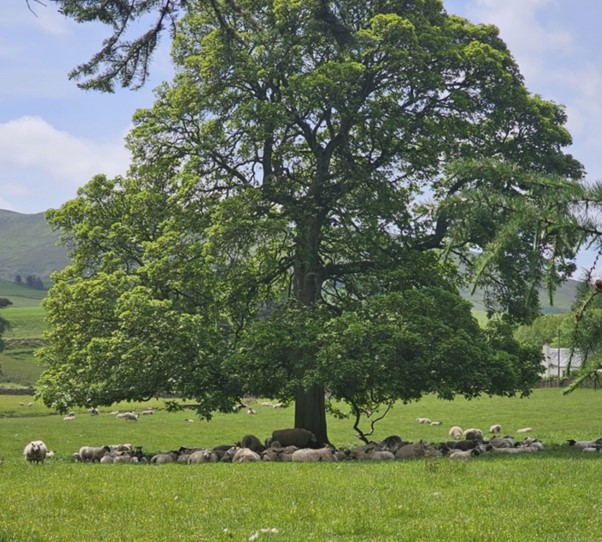
Photo credit: Albert Mvula
By Katrin Prager, Albert Mvula, and Josie Geris.
As researchers in Scotland, we know that planting trees on farms—also known as agroforestry—can bring many benefits. Trees can help absorb carbon from the air, support biodiversity, protect farmland from erosion, shield livestock from the harsh weather conditions, and even make farms more productive. Scotland aims to stop biodiversity loss by 2030 and reach net-zero carbon emissions by 2045, and agroforestry could play an important role in achieving these goals.
Despite the benefits of agroforestry, many farmers remain hesitant to plant trees on their land. Through interviews with 31 farmers—both those who have adopted agroforestry and those who have not—we identified several key barriers to tree planting. Some farmers are concerned about the potential impact of trees on their farms, while others lack clarity on suitable tree species or management practices. Financial uncertainty is also a significant factor, as many farmers are unsure whether tree planting will yield long-term profitability. Although grant schemes offer financial support, eligibility criteria often make these grants inaccessible to small-scale farmers and crofters, while larger-scale farmers may find them unattractive. Tenant farmers face additional challenges due to land ownership restrictions, which limit their ability to plant trees.
Farmers respond to these obstacles in varying ways, shaped by their attitudes, confidence, and perceived control over tree planting. Some remain committed to their tree-planting goals, recognizing the ecological and agricultural benefits of agroforestry. Others adjust their plans, selling portions of their land to companies better equipped to manage trees, or abandoning tree planting altogether. Some attempt to align their own planting initiatives with grant scheme requirements, while tenant farmers often resort to planting hedges as an alternative to trees.
Our research highlights the need for enhanced financial incentives, clearer guidance, and supportive policies—particularly for tenant farmers—to make agroforestry more appealing in Scotland. By addressing these barriers and aligning agroforestry initiatives with farmers’ priorities, Scotland can foster greater adoption of tree planting and advance sustainable land management.
 Relational Thinking