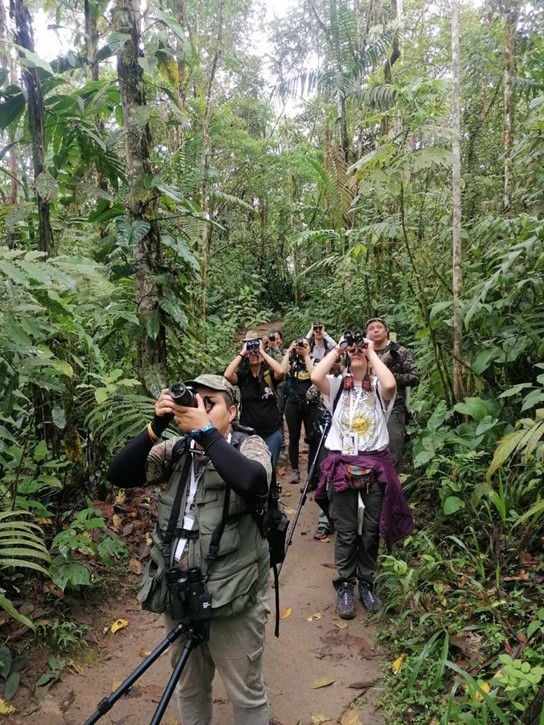
Photo: Natalia Ocampo-Peñuela.
By Natalia Ocampo-Peñuela, Sam de Alfaro, Monte Neate-Clegg, Luca de Alfaro, Katarina Bjegovic, and R. Winton.
Birdwatching is one of the most important ways in which humans relate to birds. We are attracted to their beautiful colors, relaxed by their songs, and fascinated by their behavior. People who enjoy observing birds often travel internationally in pursuit of bird species that might be unique or special to a given region, and many birdwatchers enjoy keeping track of their sightings via community science platforms such as eBird.
Our goal was to assess the changes in birdwatching activity over time and to understand what drives birdwatcher tourists to visit one country over another for their birding activities. We investigated how the amount of eBird activity in each country is related to a country’s bird capital (total and small range bird richness), its societal stability (Global Peace Index), and its Human Development Index. We found growth in eBirding activity across the world but particularly in some tropical countries such as Colombia. Not surprisingly, we found that birdwatchers prefer to visit countries with a high number of unique or hard-to-find bird species, those that have higher societal stability, and those that have a higher Human Development Index.
Some countries like Costa Rica and South Africa receive high levels of birdwatching tourists due to their rich bird faunas, while others like Venezuela, Bolivia, and Papua New Guinea, receive relatively low eBirding activity due to low societal stability, despite having diverse and unique birds. Of note is Colombia, the country with the most bird species, which has seen recent and accelerated growth in birdwatching tourism despite its troubled conflict history.
Our results highlight countries where birdwatching tourism is high but remains untapped, and those where this form of tourism is already paying benefits for its birds, their habitats, and the human communities that steward them.
 Relational Thinking