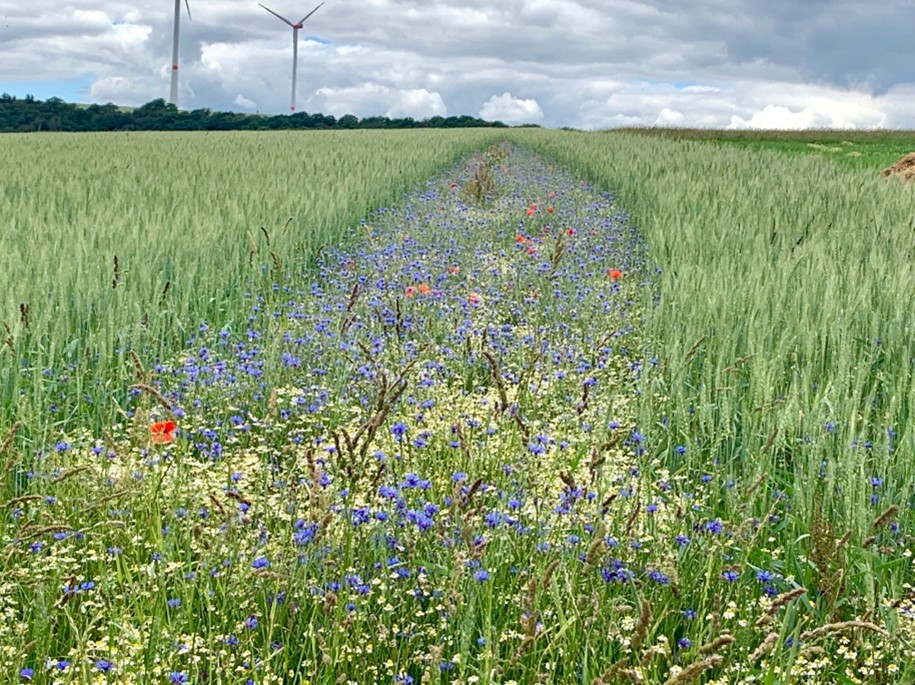
Photo credit: Christian Sponagel.
By Christian Sponagel, Amibeth Thompson, Hubertus Paetow, Anne-Christine Mupepele, Claudia Bieling, Martin Sommer, Alexandra-Maria Klein, Josef Settele, Robert Finger, Robert Huber, Christian Albert, Juliane Filser, Florian Jansen, Janina Kleemann, Vera Schreiner, and Sebastian Lakner.
We are currently facing an enormous decline in biodiversity, particularly within agricultural landscapes. Germany is a major agricultural producer in Europe, and the resulting pressures on land and land use create conflicts of interest with biodiversity conservation. Various drivers influence development that can harm biodiversity, such as the global demand for agricultural goods, environmental and agricultural policies and societal values. Each driver has a large impact on biodiversity conservation. Scientists regularly study individual drivers and biodiversity loss, but we know less about the interactions of multiple drivers acting simultaneously within the agri-food system. This system includes agricultural production at the field level and its inputs such as fertilisers or pesticides, up to food distribution, marketing and consumption.
We organised three workshops with experts from different disciplines and sectors, such as agriculture and landscape conservation, to assess the interactions and impacts of the main socio-economic drivers of biodiversity in agricultural landscapes in Germany. The results showed complex interactions. For example, societal values strongly influence other drivers such as nature conservation policy, but the development of societal values is rather independent of other socio-economic drivers. Based on these workshops, we derived four different pathways leading to improved biodiversity in German agricultural landscapes: 1) “Innovation and stricter legislation“, 2) “Major change in protein production and CAP shift“, 3) “Major change in protein production and national legislation“ and 4) “Major social changes compensate for a lack of innovation in food production”.
The four pathways all involve reduced land use pressures, stable global market supply and a paradigm shift in the role of agriculture towards more extensive production and provision of public goods. The study also highlights the potential importance of innovations in crop or protein production and the need to put them into practice. These include digitalisation, new breeding technologies or cellular meat. A change in societal values is important for improving biodiversity, which means that biodiversity needs to be given a higher priority in public communication.
These results are relevant for policy makers as they show that there is not just one way to achieve the politically agreed target of improving biodiversity.
 Relational Thinking