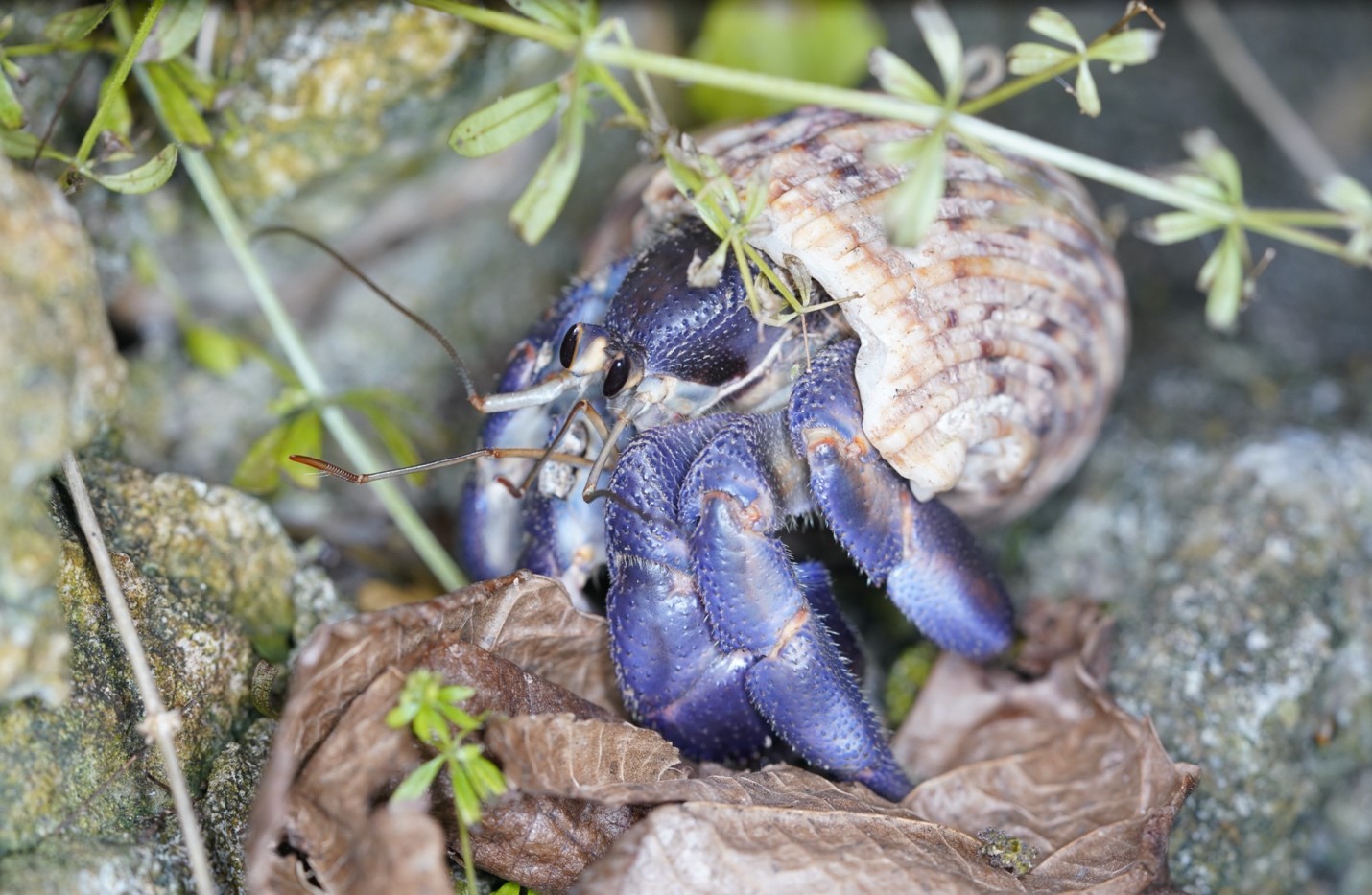
Photo credit: Chia-Hsuan Hsu.
By Chia-Hsuan Hsu, Yuan-Mou Chang, Shi-Sheng Liu, Tzu-Pi Chen, Sin-Tung Choi, Takahiro Kubo.
Most conservation efforts focus on protecting large animals like birds and mammals, but small invertebrates are often overlooked. This study looks at a land hermit crab called Coenobita purpureus, first officially recorded in Taiwan in 2017. Recently, this crab has become popular in the exotic pet trade, raising concerns about its future.
We investigated online markets, carried out field surveys, and reviewed Taiwan’s wildlife regulations. Our findings show that the price of C. purpureus rose sharply after it was scientifically described, suggesting a growing demand that could lead to unsustainable trade. We also found that where a crab is sold online and its shell color affect its price.
Field surveys revealed that C. purpureus is more widespread in Taiwan than previously thought, confirming it is native, though possibly with small populations. However, current laws in Taiwan do not adequately protect invertebrates like this crab, and we found evidence of smuggling from China through online platforms.
These issues highlight urgent gaps in wildlife trade regulations and raise concerns about invasive species risks. Based on our findings, we offer practical suggestions for better management and protection. This study shows why it is important to pay more attention to invertebrate species in conservation and trade policies to promote global biodiversity and sustainability.
 Relational Thinking