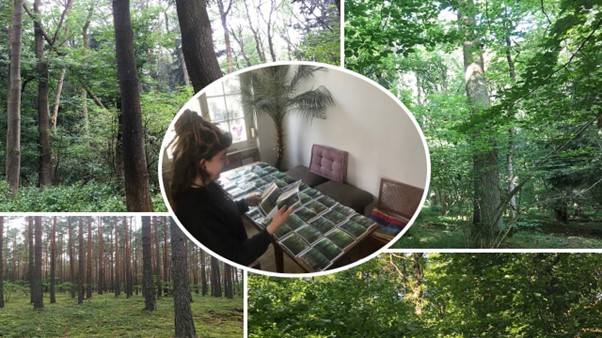
Photo credits: Kevin Rozario
The participant in the photo have given their consent for the photo to be used.
By Kevin Rozario, Taylor Shaw, Melissa Marselle, Rachel Rui Ying Oh, Erich Schröger, Mateo Giraldo Botero, Julian Frey, Valentin Ștefan, Sandra Müller, Michael Scherer-Lorenzen, Bogdan Jaroszewicz, Kris Verheyen, and Aletta Bonn.
We are facing a global biodiversity crisis. Besides tremendous ecological implications, biodiversity loss also threatens mental wellbeing, as biodiversity is linked to a better psyche. Particularly perceived biodiversity, that is, people’s subjective estimations of biodiversity, results in better mental outcomes. A better understanding of what perceived biodiversity is, and how much it overlaps with, or differs from the way expert biologists measure biodiversity is necessary.
To test this, we conducted two sorting experiments – one for the visual sense via forest photographs and one for the acoustic sense via forest audio recordings. Our goal was to obtain underlying mental representations of visual and acoustic aspects of biodiversity. We used two sorting strategies: Open sorts enabled participants to freely sort the photos and audio recordings based on anything that stood out to them when looking at or listening to the forest stimuli. Closed sorts asked participants to sort the stimuli based on perceived biodiversity. Through the open sorts, we identified perceived features that people use when classifying forests, such as vegetation density, light conditions or colour for the visual sense and birdsong characteristics, volume or evoked emotions for the acoustic sense.
People’s perception of biodiversity in the closed sorts aligned well with how biologists measure biodiversity for both senses. We also computed objective indices based on the sorting stimuli that capture certain aspects of diversity, such as variations of green within the photos or different frequencies within the audio recordings. These indices were then compared with perceived and measured biodiversity: For the visual sense, the Greenness index captured perceived biodiversity and the biodiversity measured by biologists, while for the acoustic sense, several acoustic indices, such as the Acoustic Complexity Index, did so.
We recommend to conserve and restore diverse forests characterised by a variety of tree species and structures to also provide habitats for different vocalising bird species. We provide important insights for forest management to meet conservation goals while also increasing people’s experience of biodiversity and therefore likely increasing mental wellbeing.
 Relational Thinking