Illustrated by Natasha Mannion.
By Natasha Mannion, Dr Rachel Gaulton, Maria Erica Jamil, Prof Marion Pfeifer, Prof Johan Willem Slik, Prof Stephen Willis, and Dr F. Merlin Franco.
Unsustainable hunting is a global threat to biodiversity. When new roads are constructed through tropical forests, they can facilitate greater hunting access, and drive biodiversity declines. But how do you understand how hunting interacts with road network expansion without much understanding of hunting in the first place?
Our study area, the Temburong district of Brunei Darussalam (Brunei), lies at the foot of the Sultan Haji Omar Ali Saifuddien (SOAS) Bridge, the longest bridge in Southeast Asia, constructed in 2020. Brunei is a small country on the island of Borneo, and SOAS bridge facilitates access to Temburong’s primary rainforests. Road expansion associated with the bridge is also expected to occur. Little is known about hunting in Temburong, so our study aimed to begin filling this knowledge gap, to better understand hunting and also how it may interact with infrastructure expansion.
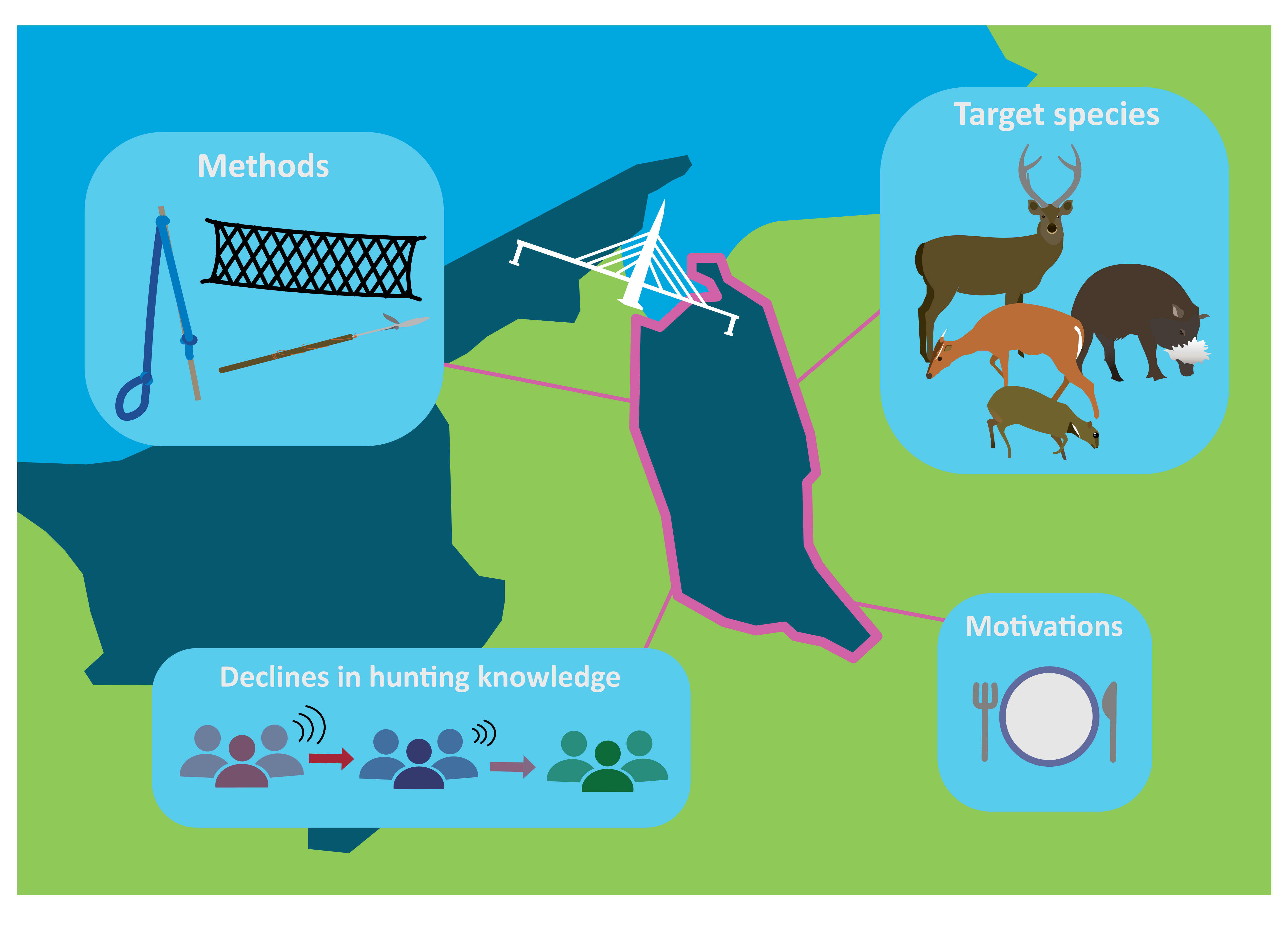
We conducted household surveys with a small cross-section of Temburong residents and in-depth interviews with hunters, asking questions about perceptions and uses of forests, hunting behaviours and motivations, and the impacts of SOAS bridge. For the first time we can report on the contemporary hunting behaviours of communities living in Temburong, including methods (snares and nets), target species (bearded pig, sambar deer, muntjacs, and mouse deer), and motivations for hunting (primarily wild meat for personal consumption). Our findings also suggest that local hunting may be gradually declining in the district, and that SOAS bridge may be directly facilitating people from outside of Temburong entering to hunt in its forests.
We discuss how Brunei’s hunting compares to other study areas in the literature, the potential implications of our findings, and highlight that factors impacting hunting behaviour are complex, nuanced, and locally-specific. We recommend that context specific research is required for effective decision-making around hunting, and how it may interact with global infrastructure expansion.
 Relational Thinking