by Danielle Denley, Alejandro Frid, Sandie Hankewich, Desiree Lawson, and Anne Salomon.
Along the west coast of North America, lush undersea forests of Giant Kelp can be seen stretching from the seafloor to the ocean’s surface, forming canopies that are home to a diversity of marine life. Kelps have also been harvested for food, social and ceremonial purposes for millennia by Indigenous Peoples of the northeast Pacific, including the Haíɫzaqv, Kitasoo Xai’xais, Wuikinuxv, and Nuxalk First Nations on the central coast of what is now know as British Columbia (B.C.), Canada. However, climate change is an increasing threat to Giant Kelp. While it’s long been known that warmer seawater can reduce growth and overall health of Giant Kelp, our collaborative research revealed a hidden impact of climate change on this foundational species.
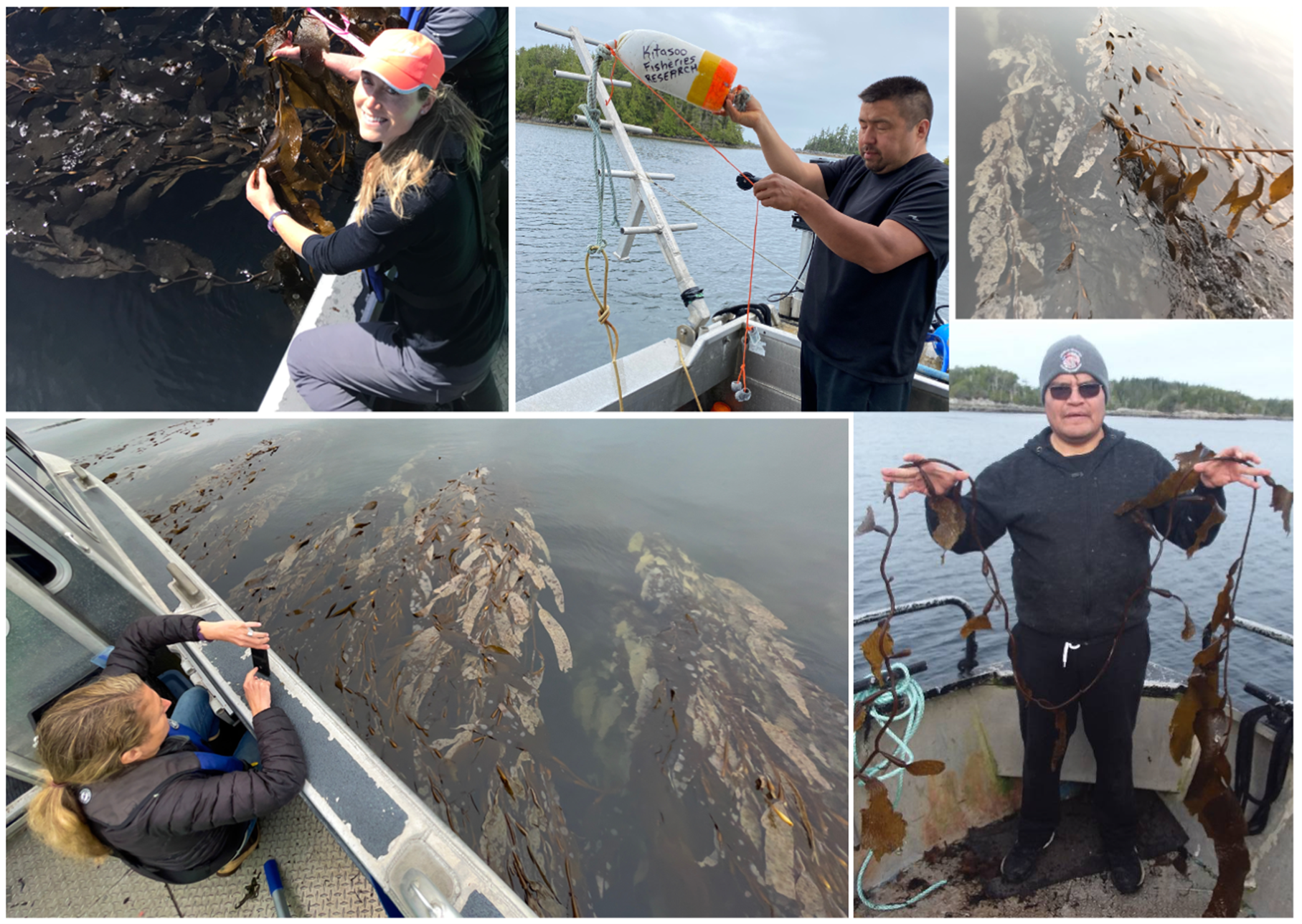
During an unprecedented marine warming event on the central coast of B.C., Indigenous Coastal Guardian Watchmen (CGW)—who protect and steward their Nations’ marine territories—observed an unusually large outbreak of a white encrusting animal, called a bryozoan, growing on kelp. The CGW reported that Giant Kelp forests became so heavily covered by the bryozoan that they sank to the seafloor and disintegrated.
In response to these observations, we co-developed and co-implemented field surveys of bryozoans, Giant Kelp, and sea surface temperatures with CGW and First Nations’ stewardship staff based on their local knowledge, previous studies, and the information needs of central coast First Nations.
We found that Giant Kelp forests with thicker surface canopies at warmer, less wave exposed sites were more susceptible to being covered by bryozoans. We also observed peak bryozoan cover on kelp ~2.5 months earlier in the season coinciding with another abnormal warming event during the second year of our two-year study.
The positive relationship between seawater temperature and the seasonal timing and amount of bryozoan cover on Giant Kelp detected by our study demonstrates another important pathway through which ocean warming can affect kelp.
Fortunately, our work also revealed solutions to this ocean climate challenge. To support healthy kelp forests and sustainable kelp-human relationships, central coast First Nations are using their ancestral laws of resource stewardship and the results of this study to adapt their harvest and management strategies for kelp. These adaptations include selecting cooler and more wave-exposed sites for kelp harvests, reducing harvests in warmer years, and starting harvests earlier in the season during years with abnormally early warming.
 Relational Thinking