The Rachel Carson Prize is awarded annually to the best article by an early career researcher in People and Nature. For full information on the prize’s history, please visit the BES website.
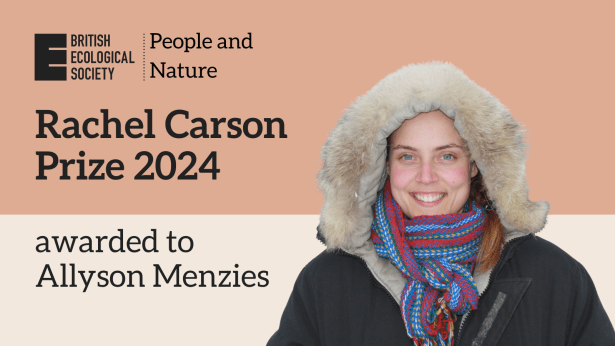
Winner of the Rachel Carson Prize 2024 – Allyson Menzies
The People and Nature Editors are pleased to award the 2024 Rachel Carson Prize to Allyson Menzies for the article ‘Sharing Indigenous values, practices and priorities as guidance for transforming human–environment relationships’, by Allyson K. Menzies, Ella Bowles, Deborah McGregor, Adam T. Ford, Jesse N. Popp (People and Nature, 6:5).
Contributing towards a growing movement towards more just, relational, and inclusive approaches to conservation, this research centers the voices of Indigenous youth, Elders, and Lands staff from 12 communities across Canada, who shared values like respect, reciprocity, humility, and responsibility as foundational to environmental care. These teachings offer guidance for transforming human-environment relationships and call on environmental practitioners to build the right kinds of relationships—with the Land, with each other, and with Indigenous Peoples.
“Winning this award is deeply meaningful,” Allyson said, “not just for me, but as a sign of growing recognition and respect for Indigenous voices in science. Not long ago, research about Indigenous peoples rarely included their perspectives. Today, we are seeing real change, with more space for Indigenous-led stories, knowledge, and leadership. I’m proud to be part of that shift.”
“One of the exciting parts of being a part People and Nature is celebrating work that challenges assumptions and practices to create space for an unfolding future of positive change,” said Lead Editor Andrea Rawluk, who handled Allyson’s paper. “Focusing on changing practices, relationships and perspectives in environmental conservation, the manuscript ‘Sharing Indigenous values, practices and priorities as guidance for transforming human–environment relationships’ does just that: going to the heart of ontological, epistemological and practice challenges in Euro-western dominated disciplines to provide academics and practitioners with constructive ways forward that are centred in justice and reciprocity. This beautiful paper provides lessons that span beyond the realm of environmental conservation and beyond the scale of Canada, to prompt reflection and practice change across disciplines and around the world.”
It was a privilege to be a conduit for these important perspectives to be shared more widely, and to help create space for them in places where they haven’t always been heard.
– Allyson Menzies.
Dr. Allyson Menzies is a Métis scientist from Treaty 1 and 2 territory in southern Manitoba, Canada. She holds a BSc Honours in Biopsychology and an MSc in Bioscience, Technology, and Public Policy from the University of Winnipeg, where she studied hibernation physiology of cave-dwelling bats. She earned her PhD from McGill University, where she focused on the winter ecology of lynx, snowshoe hares, and red squirrels, followed by a postdoctoral fellowship at the University of Guelph focused on prioritizing Indigenous values in wildlife monitoring and research. In March 2024, she joined the University of Calgary as an Assistant Professor in the Biology department. Her research blends ecological science with Indigenous Knowledge to inform conservation and co-management of culturally significant species.
Find the winning paper, and all other shortlisted papers, for the 2024 Rachel Carson Prize in our Virtual Issue.
 Relational Thinking