In celebration of the shortlisted papers for the Rachel Carson Prize 2024 for Early Career Researchers, we’re delighted to introduce you to some of our shortlisted individuals and papers.
Holly Nesbitt (she/her)
Read Holly’s shortlisted paper: ‘Social networks and transformative behaviours in a grassland social-ecological system‘.
About the paper:
What is your shortlisted paper about, and what are you seeking to answer with your research?
Our paper, Social networks and transformative behaviours in a grassland social-ecological system, examines the social and ecological factors that influence ranchers to manage juniper encroachment in the North American Great Plains. Juniper encroachment is occurring at a rapid rate, transitioning the system from grasslands to woodlands in what’s called a “regime shift,” which is extremely difficult to reverse once it’s occurred. For the Great Plains, if this regime shift continues at its current rate, grasslands will shift to woodlands by 2050, with both social and ecological consequences, including reduced forage productivity, increased water scarcity, and loss of habitat for endangered species. Because much of the landscape is privately owned, understanding the factors that promote voluntary landowner behaviour could be essential for informing more effective policy initiatives. Focusing on ranchers in Nebraska at the heart of the Great Plains, we used social (social network surveys) and ecological (landcover) data to predict rancher management behaviour. We found that collective factors (like social networks) were more important than individual factors (like risk perception) for influencing management behaviours. For example, we found that although ranchers understood the risks of juniper encroachment, this risk perception was not related to prescribed burning or mechanical removal of trees. Instead, collective factors were predictive of juniper management, suggesting that social support limits management more than an understanding of risk. For prescribed burning in particular, we argue that social support is necessary for overcoming fire exclusion paradigms and engaging in the kind of coordinated collective action necessary to burn landscapes safely. We also found that prescribed burning was not responsive to ecological factors like regime shift severity, suggesting that low social support and information access may be constraining individuals, even when regime shifts are locally severe. We argue that clarifying how social networks influence potentially transformative behaviours is essential for improving our capacity to adapt to regime shifts around the world and other forms of global change.
Were you surprised by anything when working on it? Did you have any challenges to overcome?


We administered our social network survey in the spring and summer of 2021, at a time when we were still struggling to navigate the pandemic. Our team was very collaborative, including multiple institutions and disciplines, which was ultimately a strength, but the pandemic made it much harder to come together as a group to develop and implement our survey.
A challenge unrelated to the pandemic was actually how to design and implement a paper ego-network survey. Most social network surveys that are administered now-a-days are done online, but we knew that our target population was more likely to respond to a paper survey. With social network surveys, respondents are asked to list the names of people in their network. Then the researcher asks questions about each of those people. In an online survey, it’s easy to carry those names forward through the rest of the survey, but with paper we had to think about how to ask follow up questions about each person in the network without requiring the respondent to write names out on every page. We wound up using an approach that was inspired by the varying page widths in the children’s book, the Very Hungry Caterpillar by Eric Carle (“On Monday, he ate through one apple. But he was still hungry. On Tuesday…”). These photos illustrate how we had a normal width page behind five half-width pages. This way, the respondent could turn the half-width pages to respond to subsequent questions about each of their contacts, while only having to list their contacts once. I was certainly surprised by how much I was thinking about paper sizes, folding, and stapling during that period of my PhD!
What is the next step in this field going to be?
Our research shows that collective social factors may be important levers that can be pulled by policy-makers to enable transformative change toward sustainability (and pulled more easily than individual social factors). For example, it’s probably easier to provide venues and capacity for collective action than it is to change whether an individual trusts the government. A future step will be understanding the extent to which implemented policies that target collective factors are effective, where, and for whom.
What are the broader impacts or implications of your research?
In terms of managing juniper encroachment, our results suggest several policy levers that could be effective for inspiring more wide-spread uptake of prescribed burning, which is the only management tool that can tackle the spatial scale of encroachment in a cost-effective manner. We found that ranchers who experienced high transition severity and/or understood the risks of juniper encroachment were not more likely to use prescribed burning, suggesting that a lack of information is not limiting behaviour. In other words, current efforts to educate the public on juniper encroachment are likely improving ranchers’ awareness of the issue, but this awareness is not translating into behaviour change. Instead, social factors are likely more limiting. Ranchers need physical labour, equipment, and knowledge to burn landscapes safely – all of which can be provided through social connections. Although there are considerable efforts underway to meet these needs, our research shows that prescribed burning is a collective action problem that requires social support well-beyond the individual. Providing support for prescribed burn associations and other non-profits or building extensive prescribed burning networks may be effective. Removing institutional barriers that are codified into federal and state laws or enabling rural fire districts to support prescribed burning on private lands may also be helpful. We also found that trust in government increased the likelihood of prescribed burning. Given that different agencies and jurisdictions have vastly different messaging around juniper encroachment (some providing tools to remove/burn trees while others engaging in cost-share programs to actually plant junipers as windbreaks), it should be no surprise that there is a lack of trust in government on this issue. Providing consistent messaging and juniper management could reduce sources of juniper seeds while increasing voluntary rancher behaviour.
More broadly,one of the most exciting contributions of this work ishighlighting the importance of social interactions for enabling transformative behaviour. Becauseprescribed burning challenges pervasive power structures and paradigms while simultaneouslymanaging regime shifts effectively across larger spatial extents, it has the potential to be trulytransformative for fire-prone ecosystems across the globe. Understanding how social interactions enable transformative behaviours in other contexts (such as in resource management like fisheries or more broadly in land use planning and transportation) may be a critical next step for managing social-ecological systems for sustainability into the future.

About the author:
How did you get involved in ecology?
I’ve always been interested in nature. Growing up, my family spent a lot of time exploring outdoors, which fostered my curiosity for how all living things worked and a budding passion for conservation. My undergraduate degree was in biology, with a focus in ecology. By the end of my degree, I became increasingly interested in people’s role in conservation issues so I pursued a master’s in resource management and then worked as a facilitator and decision analyst helping multi-stakeholder groups develop plans and policy for environmental issues. After working for a few years, I wanted to deepen my understanding of environmental social science and I pursued a PhD focused on the collective aspects of conservation and environmental management. So, though my roots are in ecology, I’ve mostly crossed over to the dark (read: social) side.
What is your current position?
I am a postdoctoral researcher at Boise State University in the Human-Environment Systems department. I’m currently studying the factors that enable communities to collaboratively plan for wildfire.
Have you continued the research your paper is about?
Yes and no! My overarching research interest is focused on the utility of collaborative governance as a policy tool for societal adaptation to environmental change. During my PhD, I examined how informal collective forces influenced individual capacity to navigate constraints on adaptive rangeland management to essentially “scale up” behaviours across boundaries. After concluding that individuals leverage collective social factors to implement transformative behaviours, I now seek to understand whether, where, and for whom, policies that encourage cross-boundary collaboration achieve their intended outcomes. In my postdoc role, I am studying how social-ecological conditions are related to the emergence of collaborative wildfire planning and sharing of institutional knowledge through networks across the western US.
What one piece of advice would you give to someone in your field?
This advice isn’t specific to any field really, but the work we do as social-ecological scientists (or ecologists, or social scientists, or whomever), can be really really hard. Whether it’s difficult because conservation progress is slow/demoralizing, or because collaborating across disciplines is clunky, or because defending the value of our work to colleagues/funders/politicians is exhausting… it’s hard. I have found that surrounding myself with people who are brilliant, strategic, and kind is essential. It keeps me enthusiastically inspired on the best of days and well-supported on the worst of days.
Read Holly’s shortlisted paper: ‘Social networks and transformative behaviours in a grassland social-ecological system‘.
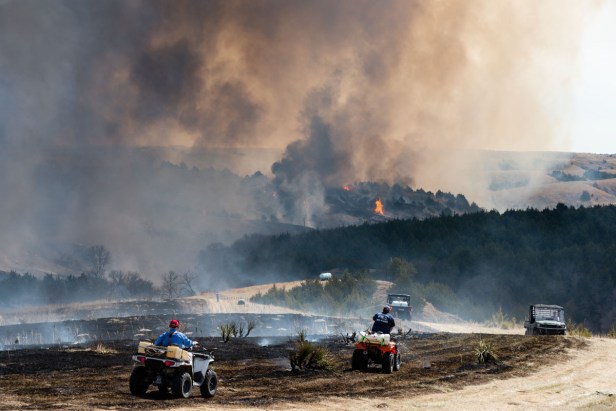
(Photo credit: Nebraskaland Magazine/Nebraska Game and Parks Commission)
 Relational Thinking