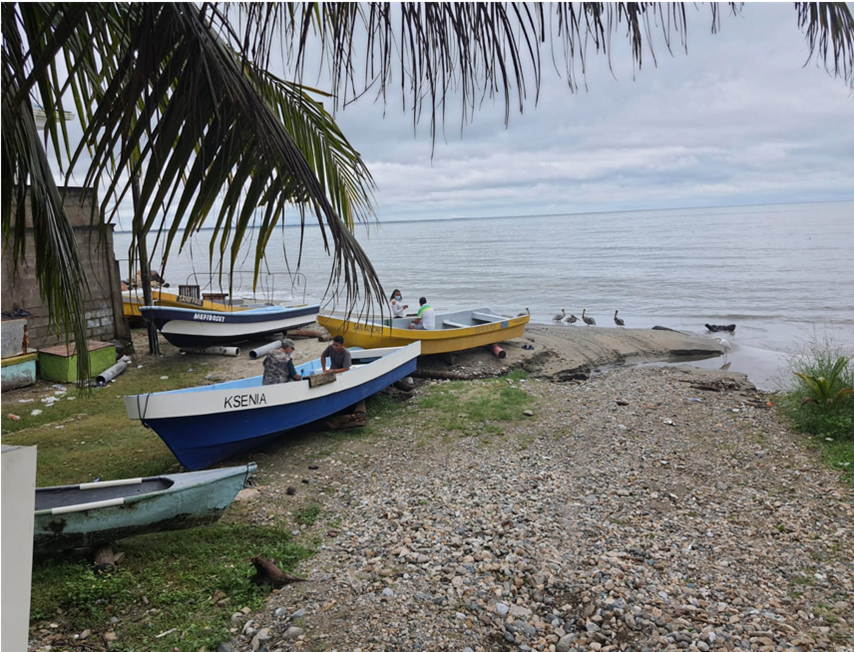
Credit: Cuerpos de Conservación de Omoa.
By Antonella Rivera, Mayra Núñez-Vallecillo, Julio San Martín-Chicas, Paolo Guardiola, Stuart Fulton, and Ricardo González-Gil.
Illegal, unreported, and unregulated (IUU) fishing is one of the greatest threats to ocean health and the livelihoods of coastal communities. In the Gulf of Honduras, a vital area for small-scale fisheries, fishers are struggling with declining catches and the challenges of IUU fishing. This issue not only threatens the sustainability of fishing resources but also sparks conflicts among neighboring countries sharing the same waters.
Our study focused on Honduran fishers who travel to the Cayman Crown reef, located in the territorial waters of Guatemala and Belize, to fish. By conducting household surveys and workshops with fishers, government agencies, and conservation organizations, we explored the motivations behind IUU fishing and the solutions that could address them.
We discovered that overfishing and environmental degradation in Honduras have pushed fishers to travel farther, often into foreign waters, to sustain their livelihoods. We also identified five key themes that could help reduce IUU fishing in the region: governance, capacity building, livelihood diversification, environmental awareness, and regional cooperation. For example, fishers want to be included in decision-making processes and better understand how their actions impact the environment. Many also expressed a willingness to explore other ways to earn a living, such as tourism or handicrafts, but they need training and resources to make this shift.
Our findings show that collaboration among governments, fishers, and conservation groups is essential to tackle IUU fishing. Unified policies between Honduras, Guatemala, and Belize, as well as community involvement in fisheries management, could pave the way for sustainable solutions. This study provides a blueprint for how low-income countries facing similar challenges can address illegal fishing through inclusive and regionally coordinated efforts. Protecting the Gulf of Honduras’ marine resources is not just an environmental issue—it’s a matter of preserving livelihoods and cultural traditions for generations to come.
 Relational Thinking