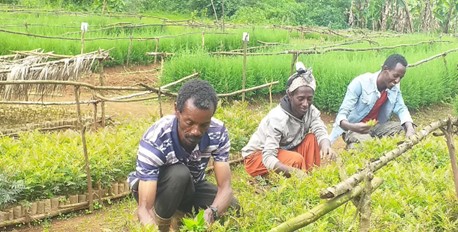
Photo by Teshome Lidetu.
By Tibebe Weldesemaet Yitbarek, John R. U. Wilson, Adrian Evans, and Katharina Dehnen-Schmutz.
Tree planting can provide various direct benefits such as wood or fruit, but the success of tree planting as a solution to environmental change often depends on whether the needs of local communities are met.
We investigated this issue across 13 tree planting schemes in Ethiopia by holding group discussions with community representatives directly involved in the schemes and by interviewing the local community members they represent.
The communities recognised that tree planting schemes are important to address soil erosion, declining crop yields, and the loss of grazing land. Communities were happy with schemes that involved them from the outset and incorporated their suggestions; such schemes also seem to have been more successful in the long term. For example, in one scheme the community was asked what their major challenges were and how they would like to be supported. The scheme then tailored its activities to address issues like soil and water conservation and irrigation support thereby improving farm productivity and livelihoods. By contrast, communities were highly critical of tree planting schemes that focussed on pre-planned activities and those that treated community members simply as labourers.
In some schemes, communities were given an official legal status, trained to manage resources, and supported with tools so they could benefit after the scheme had finished. One community successfully prevented their restored forest area from being sold to investors by using the legal framework the tree planting scheme established.
These findings underline the need for communities to be involved broadly in environmental programmes. Engaging communities effectively ensures sustainable ecological restoration, fosters trust and provides long-term socioeconomic benefits. These lessons can inform similar efforts globally, especially in low- and middle-income countries facing comparable challenges.
 Relational Thinking