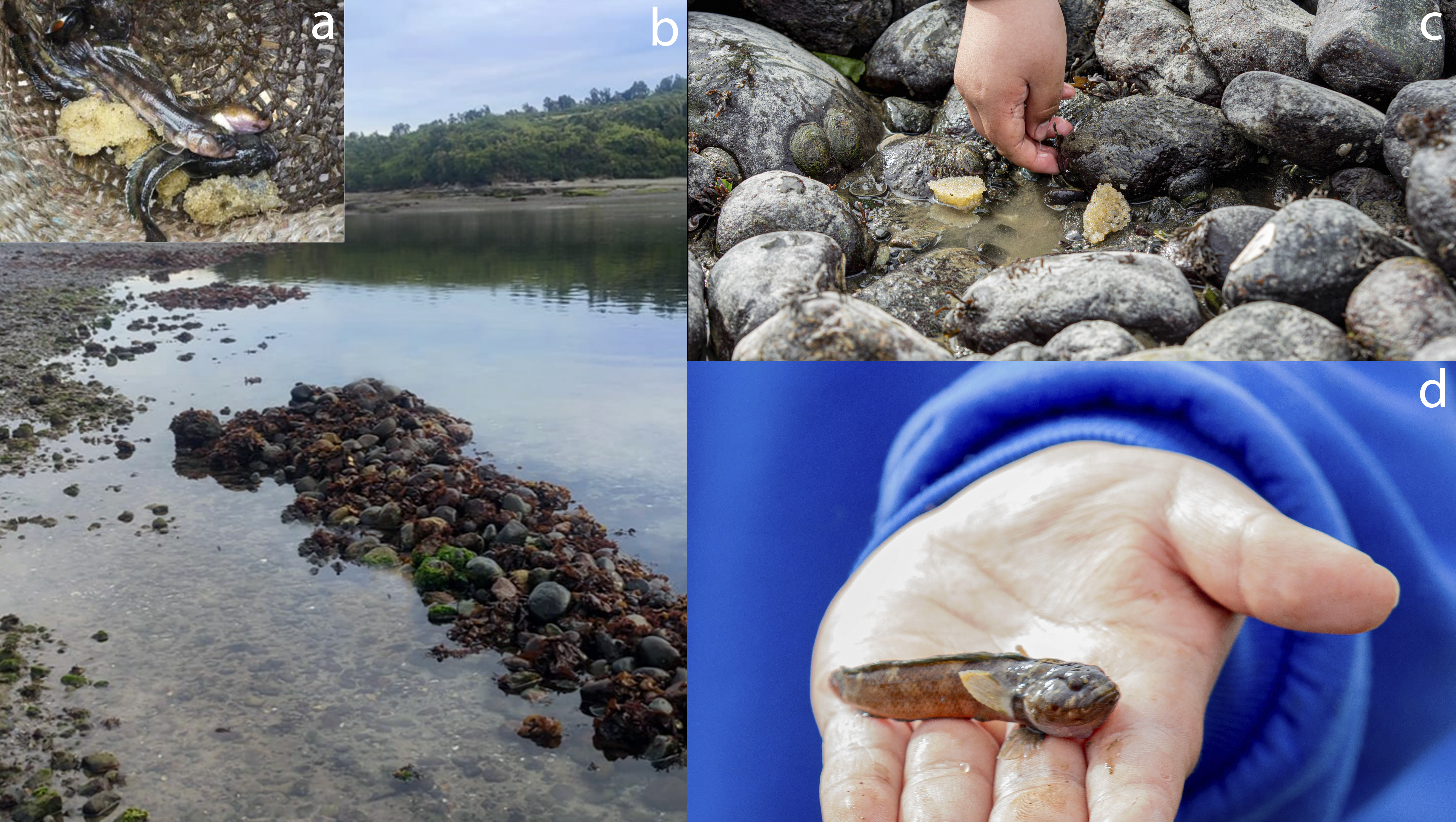
A) Pirenes (eggs) and Pilles or Coldes (rockfish) inside a basket used for shellfish (Llolle).
B) “Corralito de Pirenes” in the estuary of Apiao Island. Note the simplicity of the structure.
C) Pirenes under a rock.
D) Pille or Colde (Patagonotothen spp.).
Image: Created using photographs by Pedro Jara (2022) and Paula Barros (2023).
By Ricardo Alvarez, Daniel Caniullán, Juan Catín, Pérsida Cheuquenao, Yohana Coñuecar, Florencia Diestre, Pedro Jara, Nelson Millatureo, Darly Vargas, and Jaime Ojeda.
In Chilean marine Patagonia, Indigenous and local cultural practices for caring for coastal species have been applied since ancient times. These practices embody reciprocal contributions to both people and biodiversity, where values such as reciprocity, respect, and responsibility are central. These contributions, which include ensuring marine health, are expressed through food practices, community exchanges, and Indigenous revitalization actions. This form of cohabitation benefits people by ensuring an abundance of food and a better quality of community life. However, these contributions coexist with socio-environmental conflicts driven by neoliberal processes, such as the outward-oriented export economy and the expansion of industrial operations like salmon farming.
This article describes two reciprocal contributions that have persisted despite significant changes in the islands and coasts of northern Patagonia, and that are practiced and valued by Indigenous communities:
i) The first is the “corralitos de pirenes,” small stone walls arranged in the intertidal zone to encourage a small rockfish (Patagonotothen spp., locally called pille) to lay its eggs there. The corralitos are used by local families who maintain a way of life based on traditional customs. These families extract only a portion of the eggs, allowing the pille to use these walls annually for reproduction, thereby providing a secure food source. Simultaneously, these corralitos gradually attract other species, contributing to local biodiversity.
ii) The second contribution involves the practice of ‘enhancing’ the seabed, a task associated with Indigenous artisanal divers. Since the 1980s, the fishing boom associated with the marine gastropod Concholepas concholepas, commonly known as “loco” in Chile, has impacted subtidal bedrock ecology. In response, divers relocate Pyura chilensis (a tunicate) and other sessile filter feeders that are often found attached to rocks and serve as the loco’s natural food. This action not only attracts the loco back to the area but also restores the biodiversity that once existed, benefiting both the divers and the underwater ecosystem.
These reciprocal contributions can support local and Indigenous initiatives, such as the Coastal Marine Spaces of Indigenous Peoples (ECMPO) policy, which aims to protect the traditional use of natural spaces by communities living along coastal areas.
 Relational Thinking