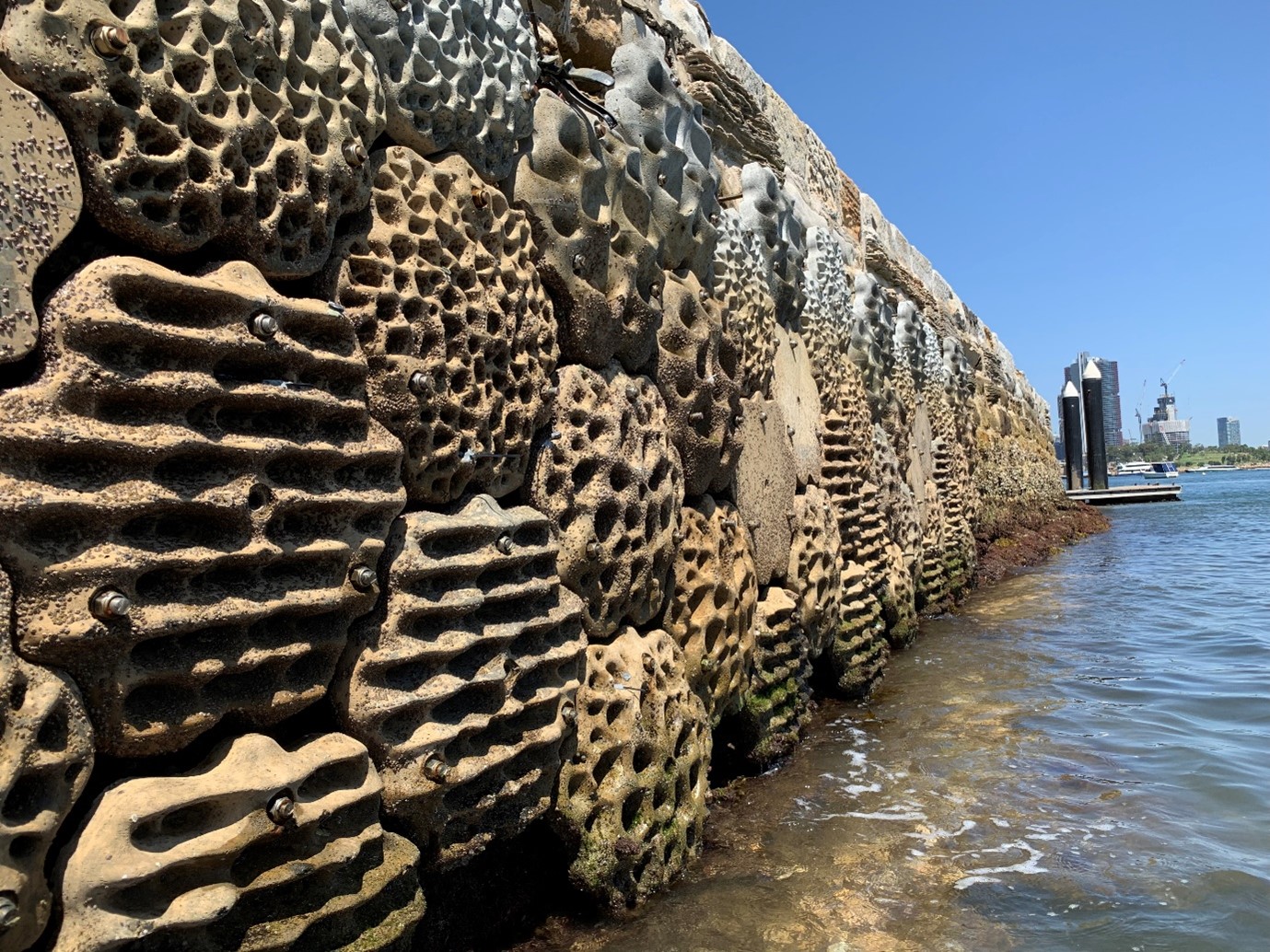
Photo credit: Maria Vozzo.
By Kate Dodds, Maria Vozzo, Mariana Mayer Pinto, Katherine Dafforn, and Melanie Bishop.
Sea defenses, such as seawalls, can be devastating for marine life. While they protect shorelines from erosion and flooding, they are often flat structures, devoid of shelter for fish, invertebrates, and seaweed. Seawall ‘eco-engineering’ offers the promise of accommodating ecological as well as human values into seawall design. Yet despite the potential of seawall eco-engineering to mitigate some of the environmental damages of seawalls, it has had low uptake. Our study sought to determine why.
Through stakeholder workshops involving built environment professionals, natural environment professionals, government officials and the public, we uncovered perceived benefits and risks of seawall eco-engineering, as well as willingness to pay, and potential funding models that may increase uptake. We found that perceived benefits of seawall eco-engineering outweighed perceived risks 2 to 1, with key identified risks including negative effects of seawall eco-engineering on the structural integrity of seawalls and the potential for it to be used in greenwashing.
Despite participants identifying many potential benefits of seawall eco-engineering, including habitat provision, increased biodiversity, more fish, and educational and stewardship values, lingering concerns contributed to seawall eco-engineering being ranked lowly among other potential environmental improvement options. Furthermore, willingness to pay for seawall eco-engineering was less than one-third the actual cost. Participants favoured funding models where government and private land-owners share the cost of seawall eco-engineering.
For seawall eco-engineering to be broadly implemented, perceived risks need to be addressed to remove barriers to implementation. This may, in part, be achieved through monitoring structural and environmental performance and sharing technical information.
 Relational Thinking