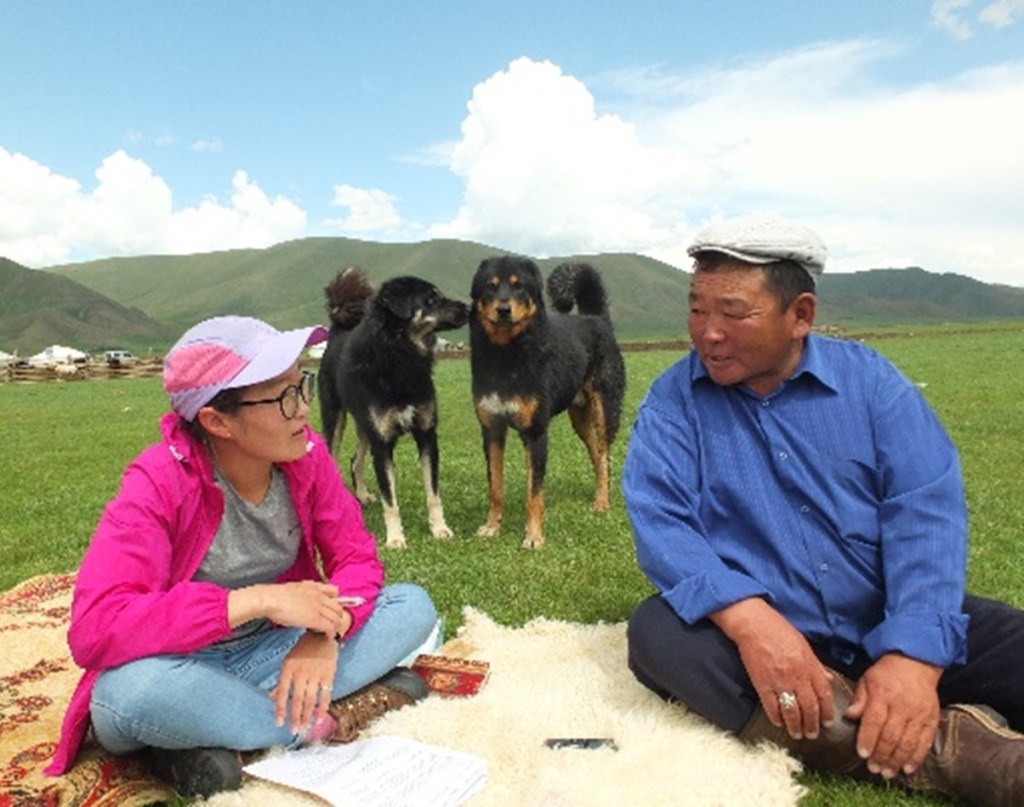
Photo by Zsolt Molnár.
By Gantuya Batdelger, Beáta Oborny, Zsolt Molnár and Batbuyan Batjav.
Extensive evidence demonstrates that traditional knowledge holders contribute to the sustainable use and conservation of nature. Researchers increasingly acknowledge traditional ecological knowledge (TEK) as key to sustainability and the successful adaptation of local communities to rapid environmental and social changes. However, implementing TEK in modern contexts remains a significant global challenge.
We compared historical and current knowledge of land management in Mongolia, where overgrazing has caused considerable pasture degradation, driven by social and political shifts that impact livestock numbers, pasture use and climate change. People often blame herders for misusing natural resources. However, it is often unclear whether the changes lie in: 1) the knowledge about the best herding practices; 2) the relevance of traditional practices in adapting to the changing social and ecological environment; or 3) the actual methods herders use to manage herds and pastures. Testing these hypotheses requires reliable historical sources of traditional knowledge and practices, which are usually hard to find. An 80-year-old book by Sambuu Jamsran in Mongolia, however, provides a unique opportunity to compare past and present knowledge and practices of semi-nomadic herders.
We interviewed 31 middle-aged or older herders about their opinions on 69 pieces of advice from Sambuu’s book. We asked herders whether they agreed with Sambuu’s advice, whether herders in their region followed the advice and their reasons for agreement or disagreement.
More than two-thirds of the recommendations were still relevant, but herders followed only half of them. The interviews revealed that herders abandoned certain traditional practices after the post-1990 socio-economic changes, even though herders were aware that the traditional practices were more sustainable and appropriate. The recommendations herders most frequently abandoned were those that required greater time investment, were less compatible with modern lifestyles, or needed closer cooperation and better-functioning institutions.
The Mongolian semi-nomadic herding system exhibits adaptability to new conditions, but the development of proper new practices by herders or the government may take considerable time. There’s a natural time lag between external changes and herders’ responses to these changes. Herders’ traditional ecological knowledge has a vital role in developing locally adaptive solutions, while institutions have a critical role in formulating regulations that can mitigate rapid changes while fostering tradition-based, sustainable, and innovative practices for the future.
 Relational Thinking