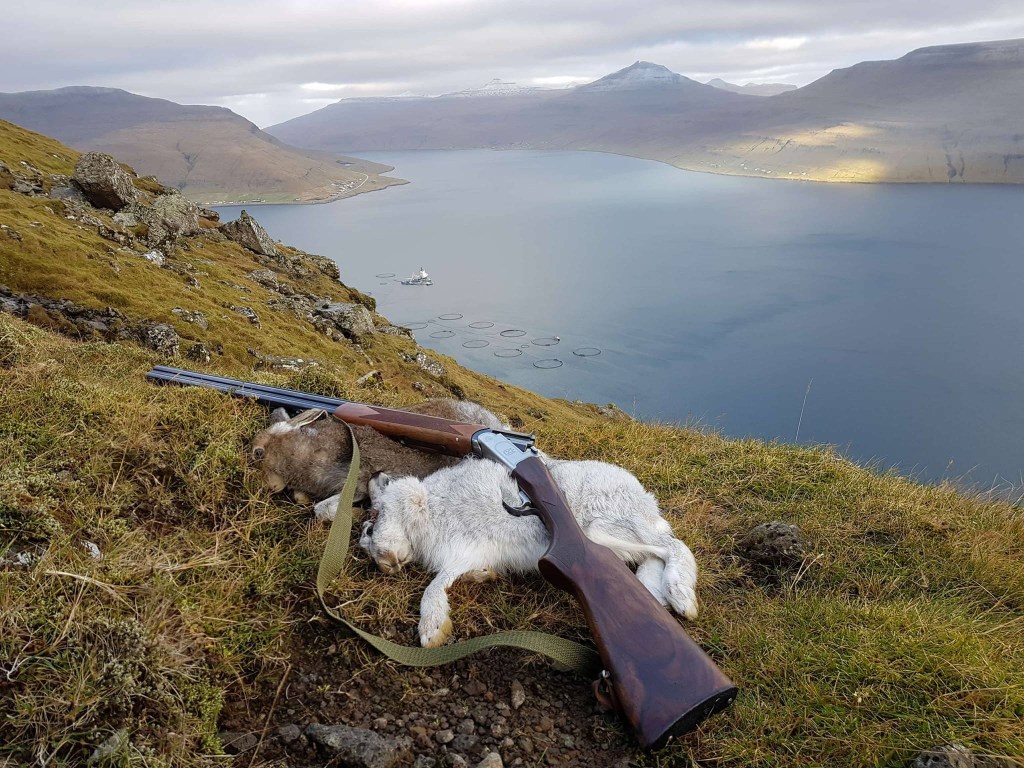
(Photo: Harald Bjørgvin).
By Tobias Plieninger, Ragnheiður Bogadóttir, Nora Fagerholm, Eydfinn Magnussen, Anton S. Olafsson, Christopher M. Raymond, and Laura N. H. Verbrugge.
Traditional practices of natural resource management are wide-spread around the world. Pastoralism, community-based forestry, and artisanal fishery are examples of traditional practices that have often fostered biodiversity while supporting local people’s livelihoods. Traditional resource uses have potential to offer guidance in responding to the world’s sustainability crises, most notably the biodiversity crisis. However, knowledge about traditional practices play in developed societies is scant, especially in Europe. Our research therefore investigates traditional hunting practices in the Faroe Islands in the North Atlantic. Traditional hunting practices of hares, pilot whales, and fulmars are widespread in this region, but some of them are highly conflictive. In our study, we ask how local values, rules, and knowledge around such hunting practices influence decision-making and how these practices are evolving over time. We aim to understand the motivations behind these activities, the challenges they face, and their sustainability. Our study is a collaboration of researchers from Denmark, the Faroe Islands, Finland, and Germany.
Using an emerging framework from sustainability science, the so-called ‘values-rules-knowledge’ (v-r-k) framework, we conducted 31 interviews with Faroese hunters. We explored the multiple societal values associated with hunting, for instance the provision of local food, the maintenance of cultural heritage, and the creation of social connections. We found that rules governing hunting were a mix of informal community norms and minimal formal regulations, with safety and respect for wildlife being key considerations. Knowledge transmission occurs predominantly through family and community interactions, with limited reliance on formal education or scientific data.
Our findings indicate that while traditional hunting persists, it is shifting from a necessity to a recreational activity. Challenges include declining interest among younger people, increased public scrutiny especially of whale hunting, and health concerns regarding whale meat and blubber. But despite these difficulties, hunting remains integral to Faroese identity and social cohesion.
Our study concludes that understanding the interplay of values, rules, and knowledge is vital for sustaining traditional hunting practices while addressing current challenges. We recommend incorporating local perspectives and participatory monitoring systems to harmonize tradition with environmental sustainability.
 Relational Thinking