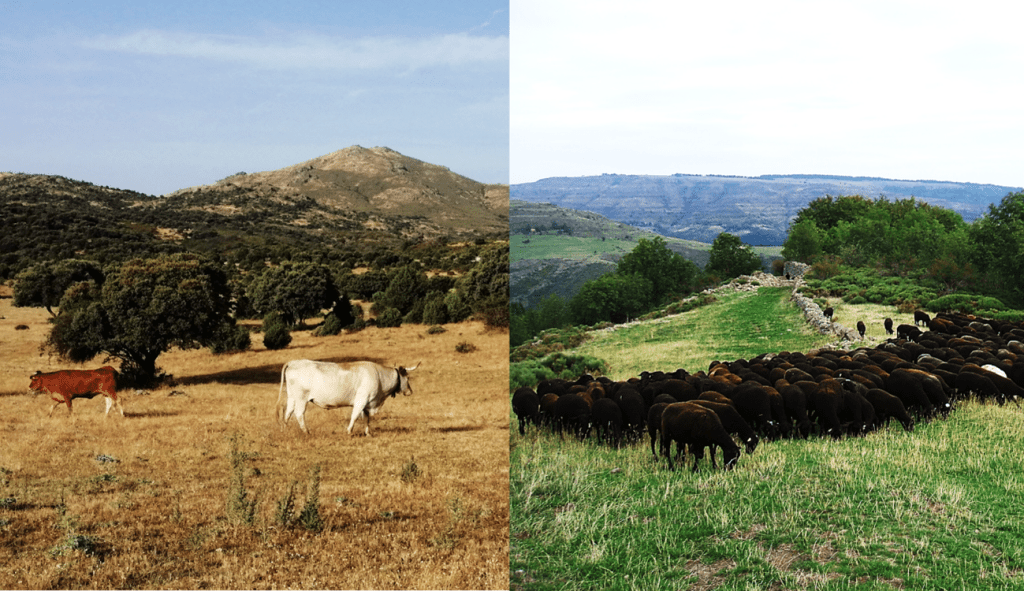
Photo credits: Pablo Acebes and Daniel López.
By Pablo Acebes, Francisco Muñoz-Gálvez, Zuriñe Iglesias-González, Marina García-Llorente, and Daniel López-García.
Pastoral practices are key for providing healthy food, keeping vibrant landscapes and the conservation of biodiversity in mountainous regions. However, the return and expansion of large wild vertebrates like carnivores (wolves), herbivores (deer, wild boar) and scavengers (vultures) in mountain regions across Europe due to land abandonment has led to concerns and challenges regarding the coexistence of wild fauna with pastoral practices. It is therefore crucial to consider the views and perceptions of key stakeholders involved in planning for optimal coexistence.
We did this in two mountain regions of Northern Madrid (central Spain). We interviewed livestock farmers, forest rangers, environmentalists, scientists (conservationists), and people from the local administration to try to find solutions that would suit everyone. Our findings show that most stakeholders perceived an increase of large wild vertebrate populations. However, people had different ideas about what this meant, with urban and rural profiles showing opposing views: while conservationists (generally urban people) considered this increase positively, farmers generally –but not always- perceived this recovery as a threat to their livelihoods. There was a consensus that wolves were attacking livestock and that preventive measures were needed to reduce the damage. Some stakeholders were concerned about the potential transmission of diseases from wild ungulates to livestock and the need to control wildlife populations. Fewer people showed concerns about the real or alleged attacks of vultures to livestock, an issue that is worrying livestock farmers.
Furthermore, stakeholders agreed on the need to be involved in decision-making through bottom-up, participative and deliberative processes. They also called for recognition of the social, economic and environmental contribution of pastoralism. The rural population, but especially livestock farmers, felt that current competition with wildlife was the final straw for an economic activity that has been threatened for decades by the rural exodus, a lack of generational replacement, falling prices, a lack of institutional support, loss of traditional practices, etc. However, new opportunities could come from European policies to support pastoral practices and harmonize them with biodiversity conservation, including the Common Agricultural Policy, the Farm to Fork strategy, and the Nature Restoration Law.
 Relational Thinking