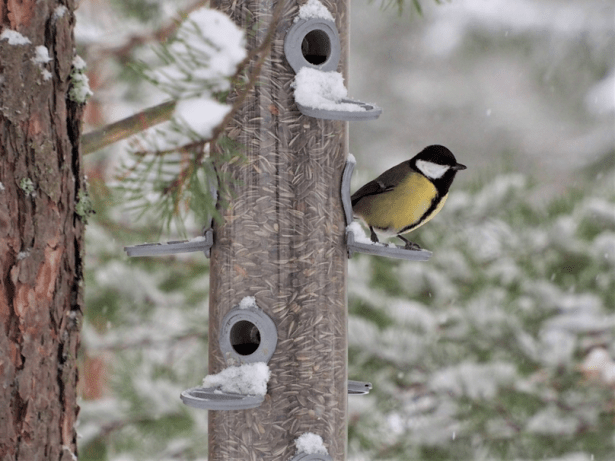
Photo: Anna Haukka
The blue tits (Cyanistes caeruleus), great tits (Parus major) and goldfinches (Carduelis carduelis) sit on the branches of the trees and eagerly observe the human adding sunflower seeds to a plastic tube with holes in it. Once the human leaves, there is constant traffic as the passerines go back-and-forth to the feeding device. They pick a seed and go to eat it in the safety of the branches of the nearby trees and bushes. Some seeds also end up stored in small cracks in the bark of the tree – the winter is long, so it is better to have food available!
Feeding birds is popular worldwide, yet there are growing concerns that these activities can have inadvertent negative effects on the birds we are trying to help. In Finland there is a long tradition of feeding birds in gardens or other close-by locations to help non-migratory species survive the harsh cold and snowy winter. However, there are now many notices and signs warning people to change this behaviour, particularly in urban areas, due to concerns over disease and unwanted rodents. Nevertheless, sales of imported bird food are increasing. Therefore, we used long-term bird population monitoring data and a Finland-wide questionnaire to better understand how and why people might be changing the ways they feed birds.
Long-term monitoring data shows declines in bird-feeding sites
In Finland, when citizen scientists collect monitoring data of bird populations, they also record the numbers of feeding locations along their census routes. These long-term winter bird censuses show that people are now offering birds food at fewer sites since the 1980s. To better understand the reasons behind these changes, we then investigated the amount of different feed types provided to birds. We separated these both datasets into urban and rural areas as people living in these areas often have different municipal regulations, social norms, demographics (e.g. fewer younger people in rural areas), and relationships to nature.
Our results show that people are changing how they feed birds in different ways in urban and rural areas. The decline in feeding of birds is especially prominent in urban areas, and particularly in the population centres in Southern Finland. Declines were less pronounced in rural areas, which make up most of the country’s land area. However, when we looked at the changes in the amount of food provided at individual feeding sites, we found that fat (usually in the form of commercial fat balls) and high-protein peanuts are now given much more often than before in both urban and rural areas, and especially the provisioning imported sunflower seeds has also increased in rural areas. Yet at the same time, there has been a decline in offering traditional, locally-grown cereal feed such as oats, and more so in urban areas. Overall, these changes mean that while feeding sites have declined, more imported food is provided to birds.
A recent questionnaire reveals reasons for changes in bird-feeding
Lastly, we conducted a nationwide survey in 2021 to ask people how and why they started, or stopped, bird feeding during the past two decades. Thanks to the survey being advertised in the Finnish broadcasting company’s (YLE) main news channels, we received 14,000 responses which we used to better understand people’s motivations.
The main reasons people changed their bird-feeding habits in urban areas were because of recommended restrictions on bird-feeding made by local governments and collective housing companies (much of the housing in Finland’s urban areas), and observations of rats near feeding sites. The brown rat (Rattus norvegicus) has a reputation of spreading disease and being a pest and is an introduced species in Finland – bird feeding stations are assumed to also provide a source of food for brown rats. Similarly, in rural areas people reduced their bird-feeding mainly due to brown rats, but also for concerns over the spread of pathogens to birds and the effort required to maintain the bird-feeding site.
Additional reasons for stopping bird-feeding included unintentionally attracting corvids, pets and forest mammals, indicating an interest in observing animals and their behaviour by the people who feed them. Most of the reasons given for changing and increasing feeding, in both urban and rural habitats, was a wish to have more birds at the site.
Feeding birds brings well-being benefits to humans, but has unclear ecological implications
The provision of food to wild animals is an activity that is seen as enhancing nature-connection for people who do it. It provides opportunities to observe and learn about wildlife, as well as positive feelings from helping animals survive, especially in winter. Despite benefits to people, the ecological benefits or harms of bird-feeding remain unclear and are only just beginning to be studied. The next step is to use the data to combine an understanding of the nuanced reasons that drive human actions in terms of bird feeding, with the actual consequences to the target species and wider ecological networks. By considering people and birds together we can enhance the wellbeing of both.
Read more and find additional references in the original publication:
Deshpande, P., Haukka, A., Rönkä, K., Aivelo, T., Santangeli, A., Thorogood, R., Lehikoinen A., 2024. How, why, where and when people feed birds? – Spatio-temporal changes in food provisioning in Finland. People and Nature 10.1002/pan3.10745
 Relational Thinking