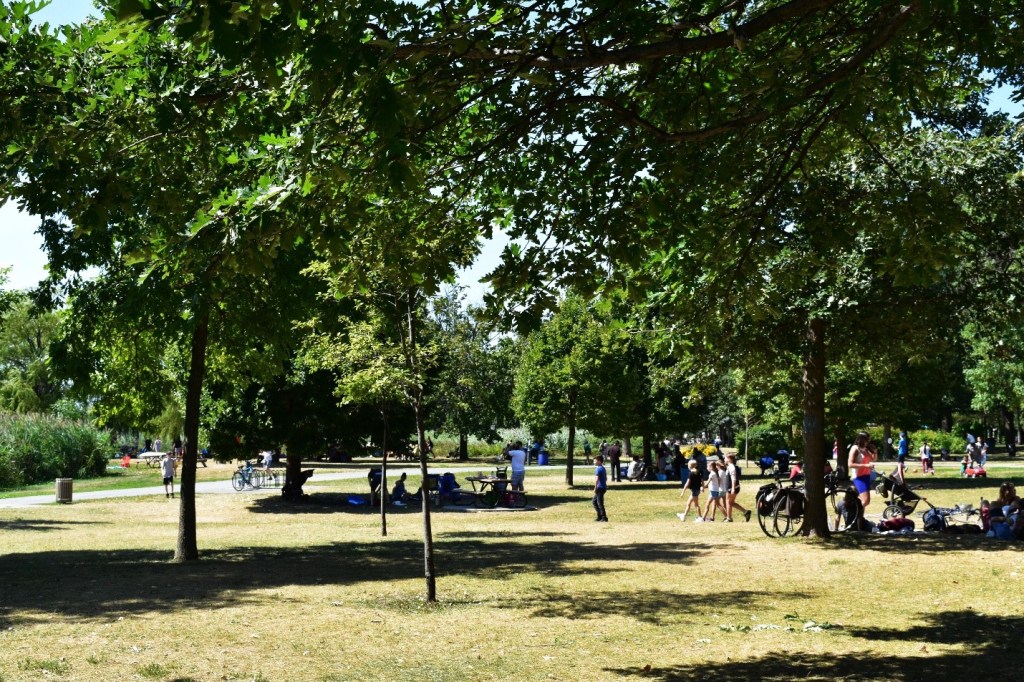
Photographer credit: Joana Silva.
By Rita Sousa-Silva, Yan Kestens, Zoé Poirier Stephens, Benoit Thierry, Daniel Schoenig, Daniel Fuller, Meghan Winters, and Audrey Smargiassi.
Go greener, be happier?
Have you heard that spending time in green spaces can make you happier and healthier? Probably yes, as the evidence for the health benefits of visiting urban nature is piling up. But are all green spaces the same? Some types of greenery might be more capable of restoring and promoting our mental well-being than others. In our research, we wanted to find out how different types of vegetation, like grass and trees, affect our well-being. We also wanted to see if the potential benefits of vegetation to mental health vary with the distance to one’s home.
We show that more greenery around a person’s home generally means higher well-being. Interestingly, we found that areas with a lot of grass cover tended to be associated with even greater benefits for well-being compared to areas with lots of trees. What’s more, this positive association remains consistent regardless of the distance from home. However, these results should be interpreted with care, as the strength of the associations we found were small and came with large ranges of likely values. But here’s another fascinating part: we noticed that adding more trees to streets seemed to have a stronger positive effect on the well-being of people who were unsatisfied with the current number of trees; it’s like they appreciated the extra greenery even more.
So, what does this mean for our cities? It suggests that if we want to enhance the quality of urban life, we should prioritise creating more green spaces, whether it’s planting more street trees in neighbourhoods or developing new grassy parks. But our study also highlights the importance of distinguishing between different vegetation types. This means that urban planners and policymakers should consider not only the quantity but also the type of greenery when designing green spaces in cities.
 Relational Thinking