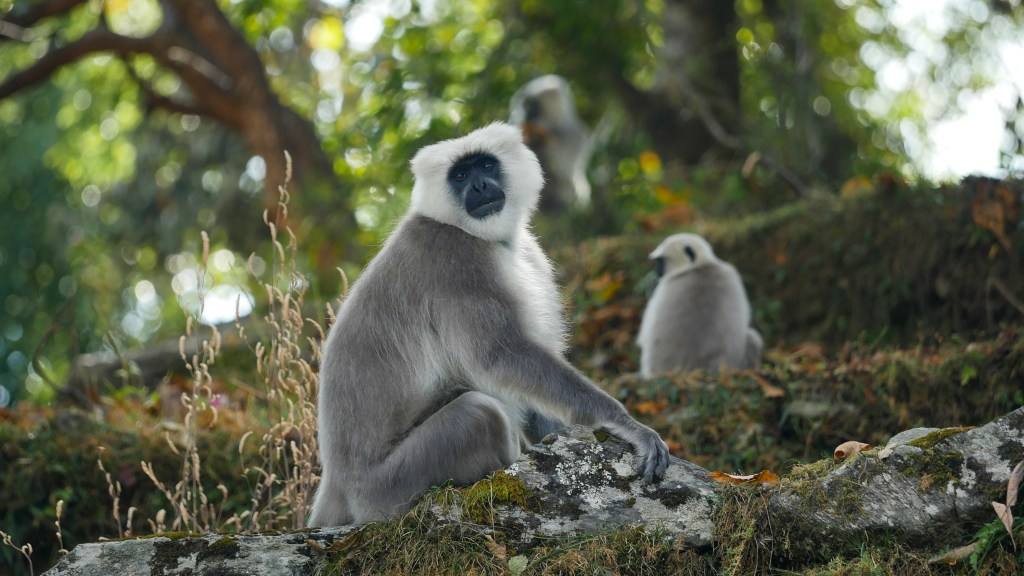
of Uttarakhand, India. Despite the challenges this species’ crop raiding behaviour poses for local farmers,
they many people with whom the langurs coexist express care, tolerance, and spiritual reverence for these
wild neighbours.
Photo credit: Madison Stevens.
By Madison Stevens, Shalini Rawat, and Terre Satterfield.
Conflict between humans and wildlife is a rising global challenge, particularly affecting rural, agricultural, and forest-dependent communities that live closely alongside wild animals. Strategies to reduce conflict largely rely on separating people and wildlife. Yet in sharing the landscape, many local communities have developed ethics of care and respect towards wildlife that enable them to coexist, not without conflict, but with a high level of tolerance. In the forests of northern India, people’s experiences of crossing paths with wild animals in community-managed forests importantly shape human-wildlife relationships. Because community forests protect critical habitat for threatened species and are the places where people most frequently cross paths with wildlife, local forest management institutions are important conservation actors. However, their role in wildlife management is under-examined and they lack legal authority to govern wildlife.
Our team sought to better understand what role community forests play in shaping relationships between people and wildlife in a high mountain valley in Uttarakhand, India. To do this, we conducted in-depth interviews and a survey of local households to discuss people’s relationships with wildlife in community forests. Our questions explored people’s perceptions of sharing the landscape with wildlife, whether they felt killing wildlife was acceptable in situations of conflict, and who they saw as primarily responsible for taking care of wildlife, and why.
We found that conflict was prevalent, particularly agricultural losses to wildlife, but that attitudes towards wildlife were generally more positive than negative. Recounting stories of their encounters with wild animals, we found that people often expressed care and concern for the wellbeing of wildlife, accepted their presence in the landscape, and generally were unlikely to support killing wildlife even in circumstances of conflict. However, we also saw a widespread sense of frustration at the government’s failure to protect people from damages caused by wildlife; this was particularly notable among members of marginalized social groups. Many people suggested that communities’ efforts to sustain healthy forests can help reduce conflict with wildlife. Together, these insights suggest that with adequate support, community forest institutions may be well-positioned to support human-wildlife coexistence in shared landscapes.
 Relational Thinking