
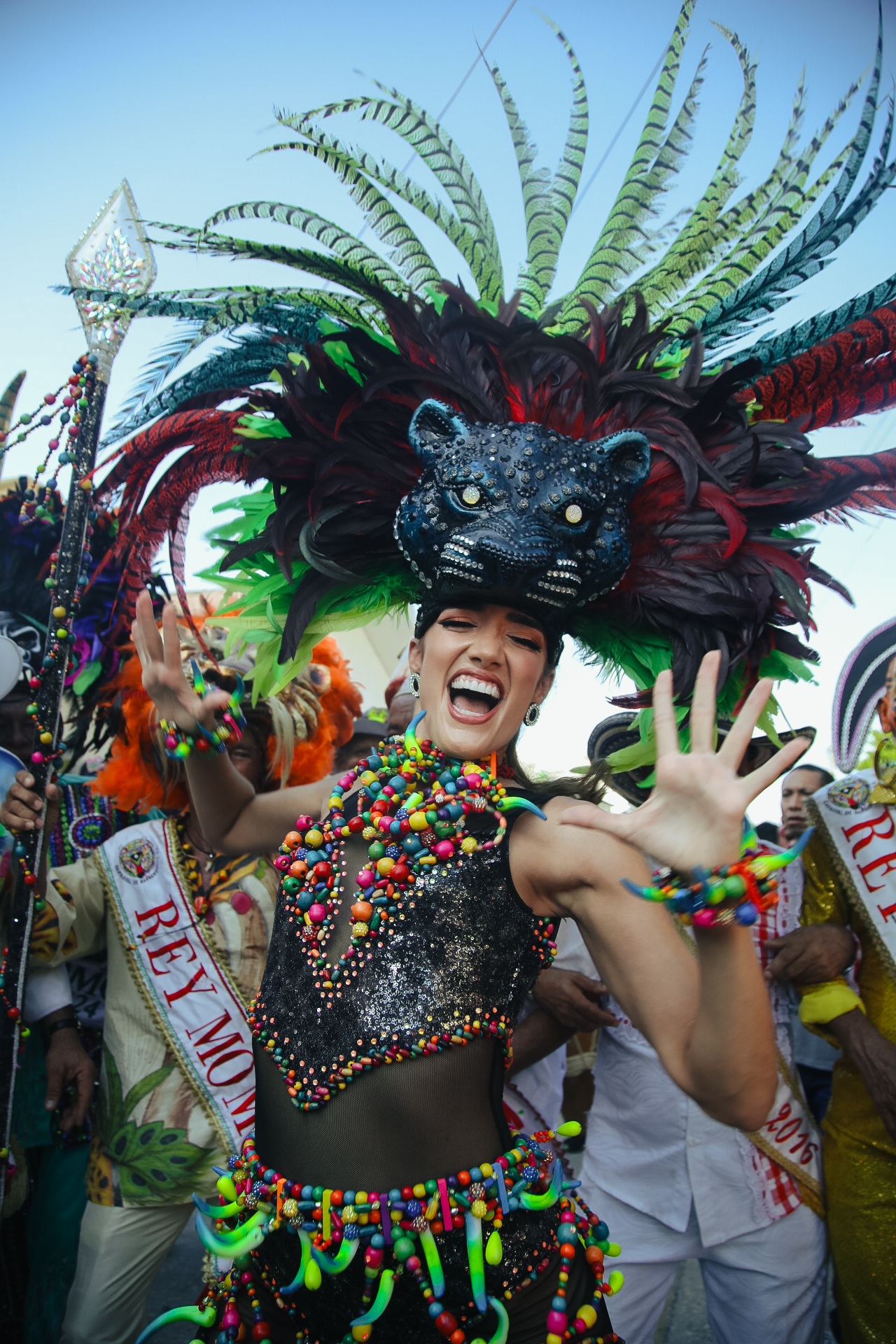
The Carnaval de Barranquilla is a month-long celebration of Colombian culture, music, dance, and traditions that takes place in Barranquilla, Colombia. The Carnaval de Barranquilla is Colombia’s biggest and most well-known carnival, and the second largest in the world. It was declared a Masterpiece of the Oral and Intangible Heritage of Humanity by UNESCO in 2003.
Here you can see the carnival queen of 2024, Melissa Cure, in her dress as a green parrot, and as the jaguar, with feathers from other animals resembling pheasants and eagles.
Photos by: Robinson Manuel Ruiz Sampayo.
By Alejandra Echeverri, Natasha M. Batista, Stacie Wolny, Guido A. Herrera-R, Federico Andrade-Rivas, Allison Bailey, Anaid Cardenas-Navarrete, Armando Dávila Arenas, Andres Felipe Díaz-Salazar, Katherine Victoria Hernandez, Kelley E. Langhans, Bryam E. Mateus-Aguilar, Dallas Levey, Andrew Neill, Oliver Nguyen, AndresFelipe Suárez-Castro, Felipe Zapata, and Natalia Ocampo-Peñuela.
Our study explored how ecotourism in Colombia could be improved by combining culture-based tourism and nature-based tourism, rather than treating them separately. We focused on mapping the overlap between biodiversity (measured by the richness of vertebrate species including birds, mammals, and fishes) and cultural richness (including UNESCO World Heritage Sites, Intangible Cultural Heritage sites, Music Festivals, and territories managed by Indigenous and Afro-Colombian communities). We then evaluated how accessible these areas were to tourists by analyzing locations popular for activities like birdwatching and sports fishing, as well as the number of visitors to national parks and arrivals at nearby airports.
Our findings revealed that although the Amazon, Pacific, and Caribbean regions are rich in both culture and biodiversity, they are not easily accessible to tourists. In fact, no area in Colombia was found to have a perfect balance of high biodiversity, cultural richness, and accessibility. The areas with the greatest potential for biocultural ecotourism often overlap with Indigenous and Afro-Colombian territories, but they remain largely untapped due to limited accessibility.
This research highlights that while Colombia has a wealth of biocultural resources, the challenge lies in making these areas more accessible to foster sustainable ecotourism that benefits both conservation and local communities. This paper underscores the critical importance of assessing the biological, cultural, and access dimensions of ecotourism. While ecotourism development can be controversial, it has the potential to serve as a mechanism for protecting biodiversity, preserving cultural heritage, and improving livelihoods. By mapping biological and cultural tourism attractions, we can identify specific locations with the greatest ecotourism potential. Our methods and results offer a framework to optimize national and regional tourism development strategies that align conservation goals with economic development and social mobility.
It is crucial that ecotourism strategies be developed in partnership with Indigenous peoples and local communities at all planning stages. This ensures their autonomy in dictating which parts of their culture and landscape, if any, they are willing to share and commodify. Biocultural ecotourism might be a pathway for developing rural Colombia in a non-extractive way, if communities are actively engaged, consulted and involved in a participatory process. We hope our method will not only be valuable to policymakers designing and implementing Colombia’s national tourism strategy, but also inform international ecotourism strategies aimed at safeguarding biocultural heritage.
 Relational Thinking