By Marie Ruth Dago, Irié Casimir Zo-Bi, Isaac Kouamé Konan, Aimé Kouadio Kouassi, Stéphane Guei, Patrick Jagoret, Anny Estelle N’Guessan, Elsa Sanial, Chloé Tankam, Souleymane Traoré, and Bruno Hérault.
West Africa, where most of the world’s cocoa is grown, has lost a significant portion of its forests in recent years. To promote trees in agricultural landscapes, both governments and private companies are encouraging farmers to plant trees alongside their crops, a practice known as agroforestry. However, many of these efforts have failed, largely due to a top-down approach that overlooks the deep motivations and needs of farmers. Understanding these underlying motivations is key to ensuring the successful adoption of agroforestry practices.
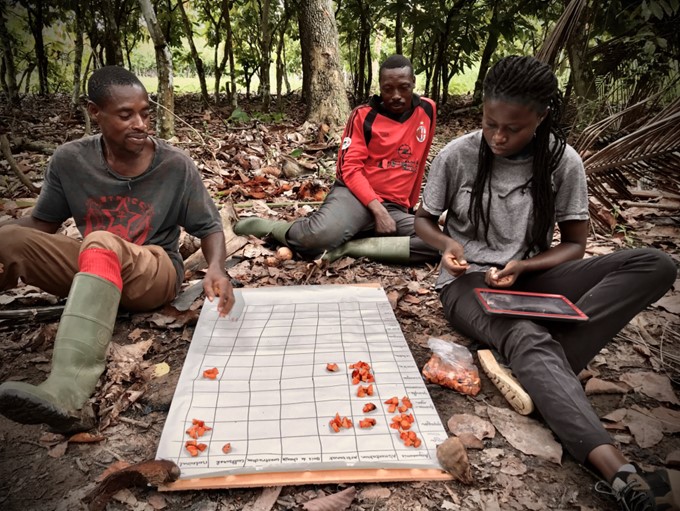
We studied 150 cocoa farmers who manage over 12,000 trees to understand their reasons for valuing trees in different ways. We examined Who the farmers are, the history of their farming systems (When), Where they farm, and the resources available in their fields (What) that influence their decisions. Our findings showed that each of these factors is important, but they matter differently depending on how the trees are used. For example, a farmer’s experience might be more important for some uses, while the type of land they have might be more important for others.
To help farmers make better use of their trees, we suggest two things. First, help farmers learn to recognize different types of trees. Second, reduce the number of less-productive cocoa trees in their fields. It’s also important for policymakers to consider all aspects of the farmer’s situation, as each farmer’s background and field conditions create both challenges and opportunities for adopting agroforestry. In the future, more research should focus on how farmers’ strategies change over time, and work should be done to create training programs and policies that support sustainable and innovative cocoa farming practices.
 Relational Thinking