By Tafesse Kefyalew Estifanos, Brendan Fisher, and Taylor H. Ricketts.
This Plain Language summary is published in advance of the paper discussed; check back soon for a link to the full paper.
Nature supports public health, but land use changes, such as deforestation, can negatively impact it. Deforestation can affect biodiversity and increase infectious diseases spread by mosquitoes, such as malaria. Research on malaria-control methods often overlooks the impact of land use changes.
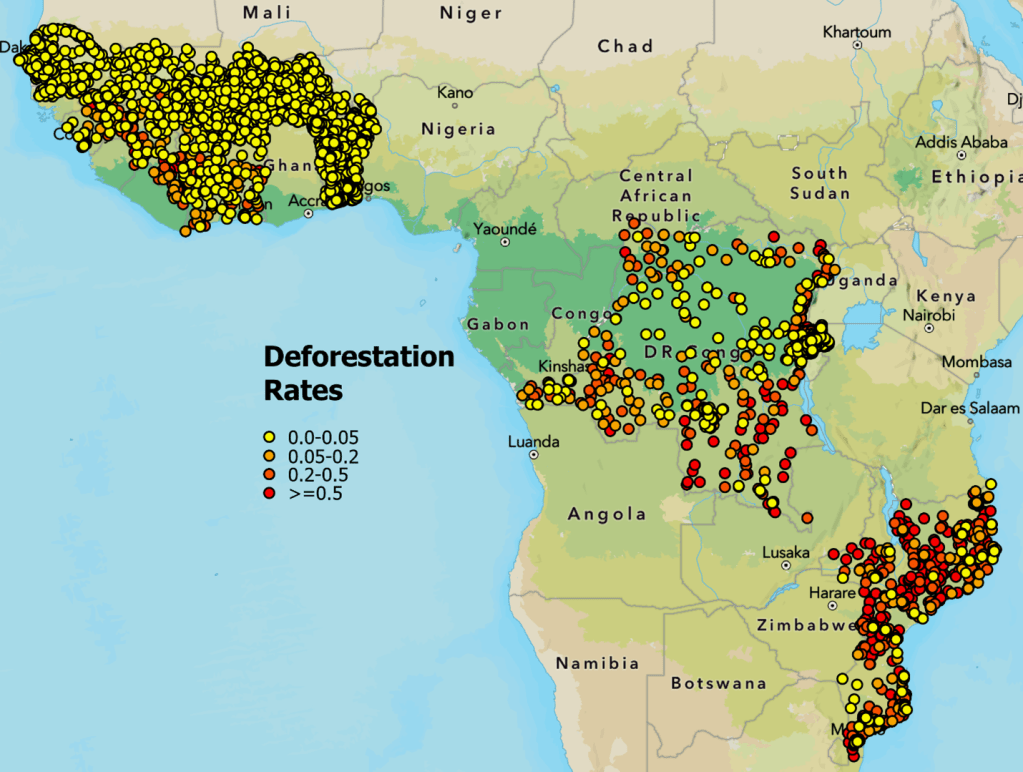
We studied the association between malaria cases (measured as malaria positivity), bed net use, and deforestation. We focused on two research questions. First, how are bed net use and deforestation linked to malaria positivity in children under five? Second, does deforestation affect on how deforestation affects the effectiveness of bed nets in reducing malaria. The study used rich dataset of demographic and health survey and forest cover data from six malaria-endemic countries in sub-Saharan Africa.
We found that deforestation is related to higher malaria rates. The odds of getting malaria increase with more forest loss. Using bed nets generally reduced malaria rates by 24.7%. However, the effectiveness of bed nets in reducing malaria varies with different levels of deforestation. In areas with 20-50% deforestation, bed nets reduced malaria rates by 32.1%. In areas with 5-20% deforestation, bed nets reduced malaria by 24.7%. However, in areas with higher deforestation (≥50%), bed nets did not significantly reduce malaria. These findings suggest that the effectiveness of bed nets in controlling malaria depends on the extent of deforestation and human activities in these areas.
Our study highlights that land use changes in regions with high malaria risk, especially among vulnerable groups, are important. Deforestation can affect malaria control by altering risk factors. Therefore, combining environmental and public health policies is needed to improve malaria control. Understanding these interactions is key for sustainable development and effective health policy.
 Relational Thinking