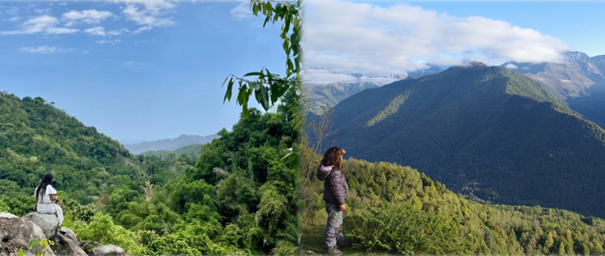
(Photo credits: Maxime Cauchoix and Memoria Viva)
By Gladys Barragan-Jason, Maxime Cauchoix, Paula A. Diaz-Valencia, Arielle Syssau-Vaccarella, Solène Hemet, Camilo Cardozo, Suzanne M. Skevington, Philipp Heeb, and Camille Parmesan.
Our study explores the ways in which people feel connected to nature and how this connection influences their well-being and pro-environmental behaviours. This feeling of being part of nature, known as human-nature connectedness, is crucial for fostering sustainable relationships between humans and the environment. While previous studies have shown that human-nature connectedness benefits adults in the Global North, it is unclear if these findings apply across different ages and in the Global South.
To address this, we conducted a cross-sectional study involving 1,858 participants aged 3 to 87 from France (1,059 participants) and Colombia (799 participants). We examined how human-nature connectedness varies with age and its relationship with well-being, pro-environmental behaviours, and opportunities to experience nature, which we assessed through factors like the level of urbanization and the amount of local forest cover.
Our findings reveal that human-nature connectedness is positively associated with well-being and pro-environmental behaviours in both France and Colombia. We observed that human-nature connectedness declines significantly from childhood to the mid-teens in both countries. Interestingly, Colombian participants generally reported higher levels of connectedness to nature compared to French participants. Additionally, higher levels of urbanisation were linked to lower human-nature connectedness in both countries.
This study highlights that fostering a connection to nature can promote sustainable behaviours and enhance well-being, even in the Global South. Our results suggest that increasing opportunities for teenagers to engage with nature could counteract the decline in connectedness observed during these formative years. Future research should expand to include diverse methods and more countries, particularly in the Global South, to fully understand the global implications of human-nature connectedness. By enhancing human-nature connectedness worldwide, we could support global sustainability efforts, not just in developed countries, but across all regions.
 Relational Thinking