By Vincent Oostvogels, Bertrand Dumont, Hanneke Nijland, Imke de Boer, and Raimon Ripoll-Bosch.
Conservationists should take stakeholders seriously in biodiversity conservation. Accordingly, we cannot afford to only consider what they value positively in relation to nature. Therefore, in this paper, we present a pragmatic framework that allows to capture both positive and negative values.
In the pursuit of fairer and more effective conservation, scientists and policymakers are showing an increasing interest in stakeholders’ values. In this context, the focus has been mostly on positive values. Nevertheless, people may also value certain aspects of nature itself, certain interactions with nature, or certain ways of governing nature negatively, due to perceived detriments to humans or nature. To truly understand what matters to stakeholders and to show that their concerns are taken seriously, we must also consider these negative values. To address this, the concept of ‘disvalues’ has recently gained attention. However, accessible frameworks that enable practitioners to consider disvalues in their real-world work are arguably missing.
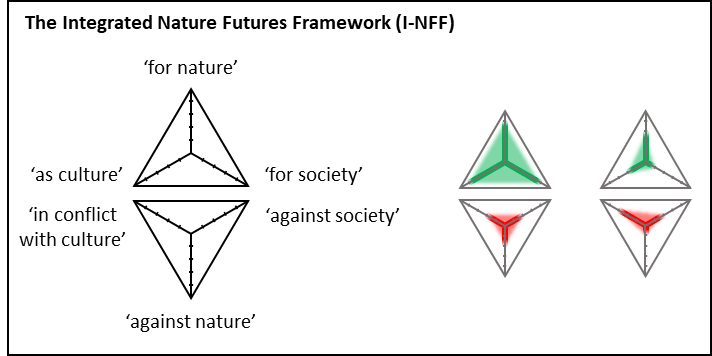
Therefore, this paper proposes such a framework. This framework draws on the popular Nature Futures Framework (NFF) to develop disvalues thinking in a more accessible form. We refer to it as the ‘Integrated Nature Futures Framework’ (I-NFF), where ‘integrated’ indicates the consideration of positive as well as negative values. The I-NFF considers three perspectives, ‘nature’, ‘society’, and ‘culture’. Based on these perspectives, nature-related matters can be characterised on a spectrum from positive (‘for nature’, ‘for society’, ‘as culture’) to negative (‘against nature’, ‘against society’, ‘in conflict with culture’). The framework, thus, takes the shape of two mirrored triangles.
Drawing from empirical work with dairy farmers in the Netherlands, we demonstrate various purposes for which the I-NFF can be used. This shows how the I-NFF can help to make value pluralism and trade-offs visible, reveal reciprocity in human-nature relationships, and identify where perspectives contrast and share common ground. We see potential for the I-NFF to elevate stakeholders’ concerns and facilitate dialogue in various contexts, and we invite others to apply, modify, or challenge the I-NFF in their work.
 Relational Thinking