By Gabriel Schepens, Jordan H. Seider, Barry L. Wesley, Darcy L. Mathews, and Brian M. Starzomski.
People have intentionally shaped ecosystems for millennia, using a range of tools, knowledge, and relationships to care for the land and increase the abundance of important resources such as food, medicines, and materials. Globally, many Indigenous Peoples continue to care for ecosystems with activities based on relationships and extensive knowledge systems, a practice often called ‘Indigenous stewardship’. When Indigenous Peoples and their stewardship practices are excluded from landscapes, the once-stewarded landscapes begin to shift into unhealthy states.
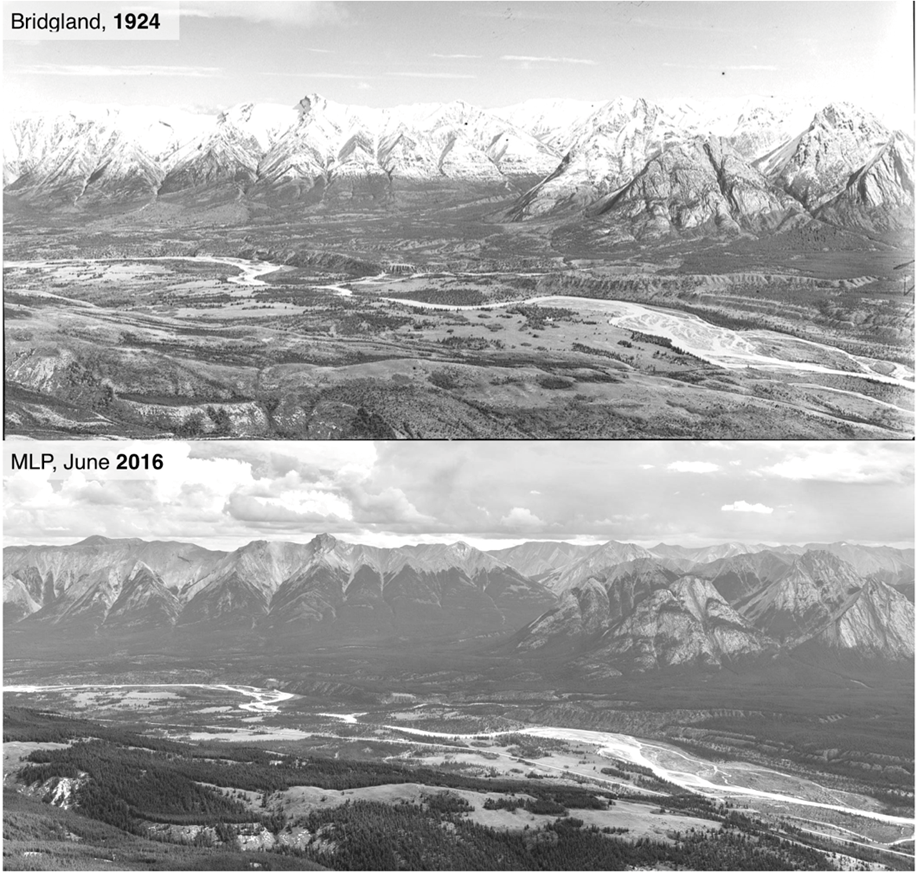
In the Egnuck Wida mountain grassland, near Banff National Park, the Stoney Iyethka Nations stewarded the landscape to keep areas open and encourage the growth of important plants like berries, roots, medicines, and food for wildlife. The goal of this study was to look at the ways in which plants and landscape have changed in the time since the colonial exclusion of Stoney Iyethka people and their stewardship. To do this, we learned about the land and Nation from Stoney Knowledge Holder Barry Wesley, carried out plant surveys, and compared old photographs to present-day satellite images. We also tested other reasons that the landscape might have changed, such as differences in climate.
From analysis of historic photographs, we found that present-day grasslands are only a quarter of the size of those in 1924; forest or shrubland has invaded the other 75%. On the ground, we saw that places once covered in flowers and grasses had been replaced by shrubs over the past 40 years. Some of the species lost include important food, medicine, and ceremonial plants, making it harder for community members to harvest in their territory.
Combined lines of evidence point to the loss of Stoney Iyethka stewardship as the main reason for the changes we observed, with little influence of climate change. This study highlights the importance of Indigenous stewardship to ecosystem health, and acts as a case study of failed crown-led conservation management. Future planning must support Indigenous-led land stewardship activities, which are a right of Indigenous Peoples and are essential to achieving conservation goals.
 Relational Thinking