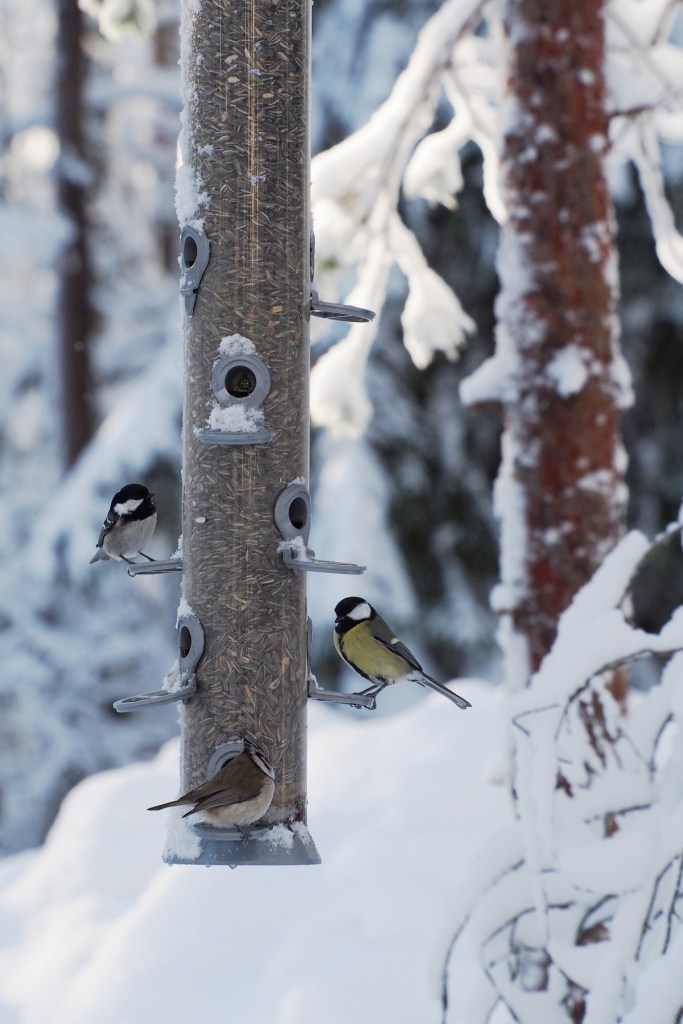
Photo credits: Anna Haukka
By Purabi Deshpande, Anna Haukka, Katja Rönkä, Tuomas Aivelo, Andrea Santangeli, Rose Thorogood, and Aleksi Lehikoinen.
Providing wild birds with food is a common activity that is practiced globally. This is particularly true for the colder regions on the world, for example, North America and Europe. People who feed birds report feeling more connected. However, the consequences of this feeding on wild birds are still being understood. Simultaneously, people who feed birds face many challenges like increasing costs of bird feed or restrictions from housing companies against feeding. Using Finland as a case study, through an online questionnaire and two long-term monitoring datasets, we have explored the reasons behind why people change their bird-feeding habits.
First, we found that there is a decrease in feeding sites in Finland which is explained by a strong decrease seen in urban habitats as compared to rural habitats. Next, we also found that there is a difference between the amount and type of food provided to birds in urban and rural environments, with sunflower seeds being the most prominent food provided to birds over the years. Finally, the decrease in feeding sites in urban areas can be explained by restrictions people face from their housing companies in an effort to not attract rats to the premises with left-over food. This is not seen as a major problem in rural areas of Finland, where the primary reasons reported to stop bird feeding were the maintenance of the feeding sites, like cleaning and refilling, along with concerns about diseases spreading among birds at the feeders.
Overall, our results show that people who feed birds have to make many decisions to decide whether or not to feed birds. Understanding the perspective of the provisioners along with the ecological consequences of bird feeding on birds will help us better design policy that benefits both birds and people who feed birds.
 Relational Thinking