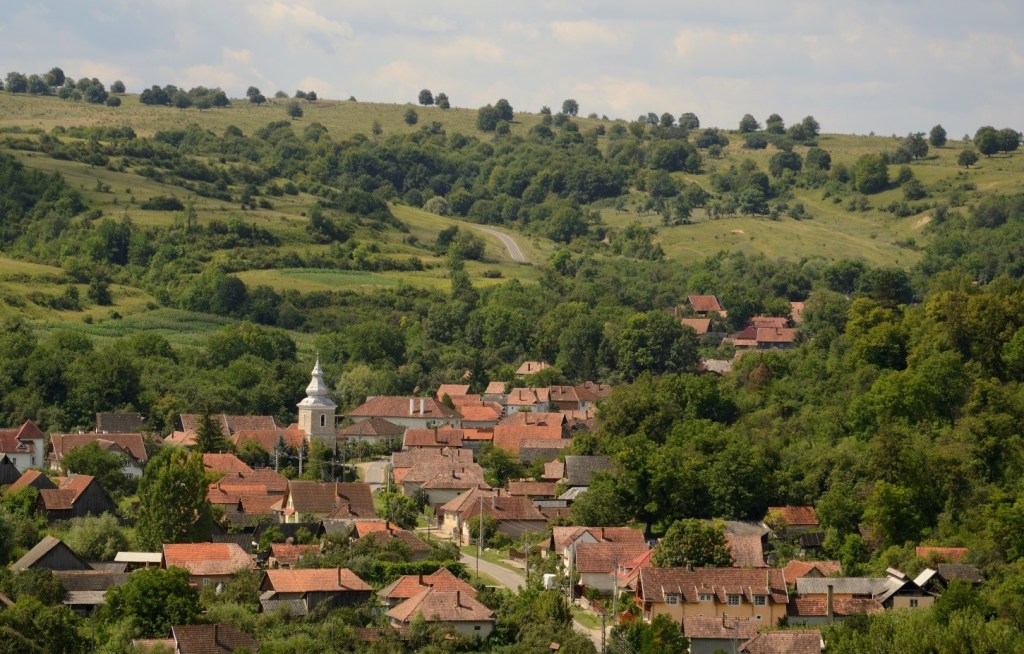
Photo: Ábel Péter Molnár
By Marianna Biró, Krisztina Molnár, Kinga Öllerer, Réka Szilágyi, Dániel Babai, Csaba Molnár, Zsolt Molnár.
This study explores how society shapes the current ecological patterns and dynamics of a rapidly transforming cultural landscape in Transylvania, Romania. Such landscapes are highly reliant on the continuation of traditional management practices, and even harbour grasslands that hold world records for plant species richness. Our goal with this study was to learn what social factors and changes have affected the vegetation and land use practices over time.
We conducted oral history interviews in two villages. In these interviews we covered the last 70 years of local history, reflecting three major periods: before, during, and after collective farming that was central to the communist economic regime of the second half of the 20th century. We found that country-scale political and economic changes indirectly influenced landscape change. The main driver was the collective farming system, with crop outflow from 1962 until the fall of communism in 1989, resulting in continuous labour outmigration to the cities, increasing from the 1960s onwards. As the remaining population aged, less time, capability and attention was devoted to the physically demanding activity of haymaking. Together with other driving factors, this demographic change led to a major transformation of the traditional cultural landscape by the 2010s. Nowadays the grasslands are maintained by sheep grazing, threatening their species richness, which depends on extensive haymaking. We identified 47 land-use legacies (vegetation characteristics that indicate former land-use activities) recognisable in the grasslands, for example, unexpected species composition and landscape patterns, and classified them into general legacy types. Our results support the finding that there was a missed opportunity for an innovative revival of the cultural landscape after the fall of communism. At that time, local knowledge, mentality, and willingness to manage the landscape were still present, but financial assets, policies, and government measures were not supportive enough.
By creating knowledge partnerships, we can still learn about the past management and functioning of such biodiversity-rich cultural landscapes from the people who actively maintained them. This would be essential for reversing current negative biodiversity trends in several cultural landscapes and supporting the planning of appropriate conservation management and subsidy schemes.
 Relational Thinking