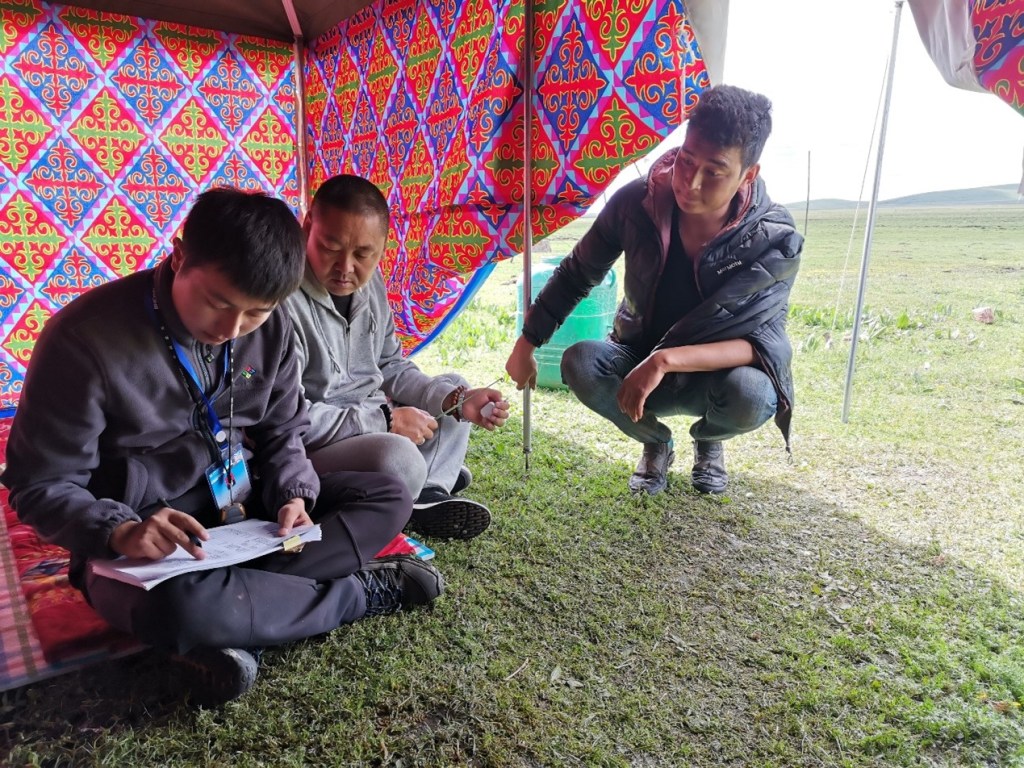
Photographed by Shanshan Li, June 2020
By JianXin Jiao, ShanShan Li, WenYin Wang, LingYan Qi, A. Allan Degen, YanFu Bai, Ting Jiao, and ZhanHuan Shang.
The Qinghai-Tibetan Plateau is known as the “Third Pole of the Earth” and is characterized by high altitude, low oxygen level, and strong ultraviolet radiation. Despite the rapid development of modern animal husbandry, people here still rely on the traditional grazing of yaks and Tibetan sheep on grassland for their livelihood. Unfortunately, over the past few decades, the grasslands have degraded substantially, resulting in reduced forage yields, an increase in toxic weeds, and the peeling of the turf.
We surveyed herders from 51 pure pastoral villages across four counties in the Qinghai-Tibetan Plateau region who participated in the grassland contract policy to understand their family structure, grassland status and livestock management, and their views on grassland degradation. We combined relevant land policies to determine how grassland degradation occurs from both social and natural factors.
It emerged that most of the grasslands are still severely degraded. The main reason was that most herders did not have sufficient grassland for rotational grazing to allow land recovery, and could not provide adequate forage for their livestock. With the increase in human population, overstocking became prevalent, leading to further degradation.
We proposed some simple options for government policy and grassland management to mitigate the impact of grassland degradation and ensure the continued prosperity of traditional animal husbandry and natural ecosystems in these areas.
 Relational Thinking