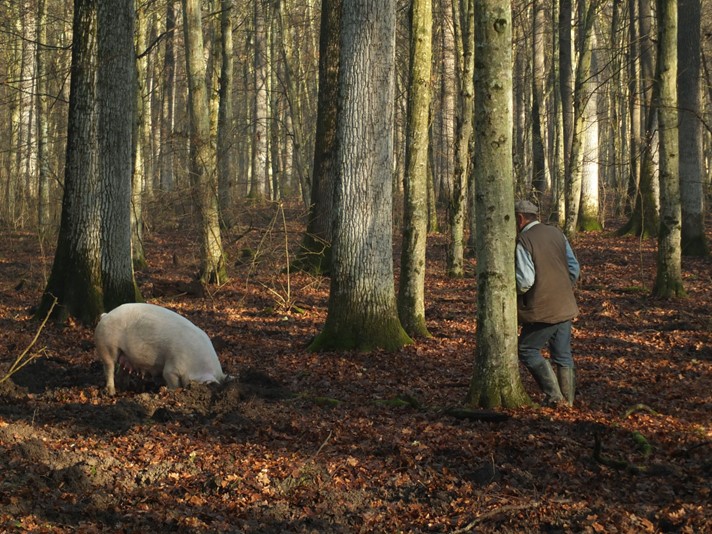

Left image: Milutin Ajvazović (a traditional svinjar) helped us, ecologists to understand what and how pigs forage on the Sava floodplain (Photo: Zsolt Molnár)
Right image: Visual observation of free-range foraging pigs (Photo: Ábel Péter Molnár)
By Zsolt Molnár, László Demeter, Klára Szabados, Alen Kiš, Milutin Ajvazović, Borislav Runjanin, Vlada Mandušić, Marianna Biró, Kinga Öllerer, Jelena Marinkov, Viktor Ulicsni, Dániel Babai, and Krisztián Katona.
An increasing number of publications advocate the use of traditional and indigenous knowledge alongside scientific knowledge, but few actually go into the ecological details of knowledge co-production. We reviewed what, when and how domestic pigs eat if they are kept free-ranging in forests and marshes. And we met ‘gourmet’ pigs.
Pasturing pigs in forests, grasslands and marshes substantially contributed to the welfare of landlords and peasants for centuries in Medieval and Modern Europe. The ecological literature is poor, however, regarding the foraging behaviour of free-ranging pigs. We need to deepen our understanding as pig pasturing is increasingly advocated for conservation management and organic farming. Our review on what, when and how pigs eat if they are kept free-ranging showed that pigs are gourmet omnivores, optimizing and switching between foraging on earthworms, acorns, grasses, corn and other forages.
As a novelty, we not only reviewed the relevant scientific literature on free-ranging domestic pigs and wild boar foraging in Europe, but analysed available data from historical and ethnographic sources from the Pannonian biogeographical region. Furthermore, we worked closely with traditional pig keepers (svinjars) and by roaming together with their tame pigs we also made our own visual observations of pig foraging in the forests and marshes of the Serbian Sava river floodplain.
Differences in the contributions of knowledge sources to our cross-knowledge system review were more than we expected. These differences were mostly the result of highly diverging interests and methodologies of those people who generated the information. Sources were complementary, filling each other’s knowledge gaps, while discrepancies between sources were rarer than we expected. Archived traditional knowledge differed considerably from living knowledge of svinjars, and scientific knowledge on pig and boar foraging differed from traditional knowledge. Svinjars deeply understood the consumption and avoidance behaviour of pigs towards 98 and 56 plant taxa, and 42 and 17 animal taxa, respectively. Wild boar scientists provided rich information on the seasonality of foraging, while the comparison with the historical-ethnographic literature proved that svinjars still keep many ancient knowledge and practices. The literature on domestic pig foraging was the poorest in information.
We discuss both the benefits (e.g. diverse information, novel cause-effect explanations) and the challenges (e.g. how to verify reliability, how to prepare culturally respectful syntheses) of cross-knowledge system reviewing to help others aiming to prepare such reviews. We argue that cross-knowledge system reviews not only help identify and overcome limitations in our ecological understanding, but may provide a shared understanding among collaborating partners, build trust, and foster acceptance of each others’ knowledge as legitimate. Traditional ecological knowledge of free-range pig keeping in forests and marshes is a rapidly disappearing intangible cultural heritage of European importance. Please help to save it.
 Relational Thinking