Photo credit: Robert Anderson.
By Julia von Gönner, Torsten Masson, Sabrina Köhler, Immo Fritsche, and Aletta Bonn.
Volunteer participation in freshwater monitoring projects, also known as ‘citizen science,’ can enhance participants’ understanding of rivers and streams. It can also improve participants’ ability to monitor stream health and motivate them to engage in jointly organised actions to protect their streams. Citizen science monitoring projects collect data on ecosystem health. They often also aim to promote learning and environmentally-friendly behaviour among participants. To date, however, there are few studies that can reliably assess the influence of citizen science on participants.
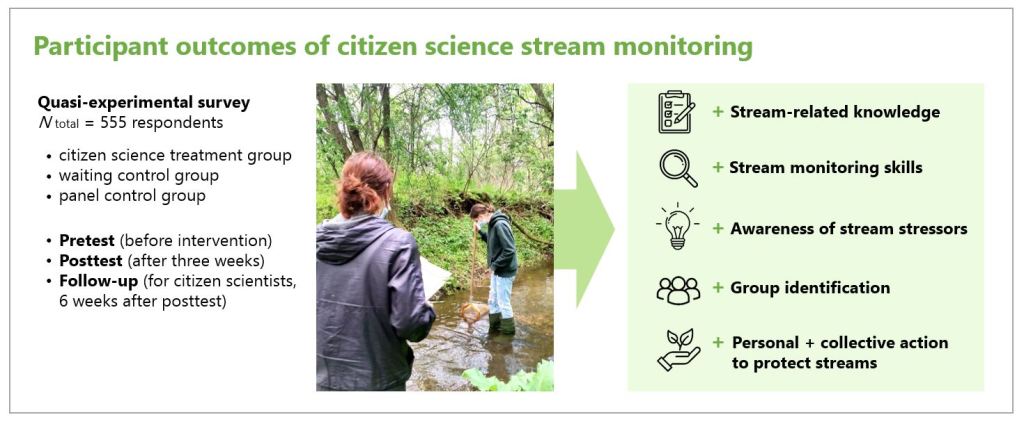
To investigate whether and how citizen science can influences participants’ learning and behaviour related to freshwater protection, we surveyed 213 volunteers before and after they participated in a citizen science stream monitoring project. We compared their responses to 342 control individuals who did not participate in the citizen science project. Our results suggest that participants’ knowledge and skills for stream monitoring strongly increased. After taking part in the citizen science project, participants felt more aware of the factors that endanger streams. They also reported a stronger sense of connection with their fellow volunteers, and more frequent participation in joint actions to protect streams. These included, for example, collecting rubbish or planting trees on river banks.
Our results offer several implications. Citizen science is a useful approach to promote people’s understanding of rivers and streams and initiate community action to protect streams. This is encouraged by in-person, hands-on training for participants, networking opportunities and exchange among volunteers during the citizen science stream monitoring events. Since our study covered a relatively short time period (9 weeks), more long-term studies are needed to clarify how participation in citizen science affects participants’ learning and behaviour in the long-term.
Many rivers and streams in Europe are in a poor condition due to habitat changes and pollution. To enable citizens to participate in freshwater monitoring and protection, we recommend that decision makers support citizen science in freshwater monitoring. In this way, volunteers, researchers and civil society organisations can actively work together to restore the health of our rivers and streams.
 Relational Thinking