By Marcus Hedblom, Fredrika Mårtensson, Åsa Ode Sang, Björn Wiström, and Anna Litsmark.
In this paper, we highlight the potential of combining children’s play, learning skills, and health with species habitats by designing and managing multifunctional green spaces. Children are increasingly being disconnected to nature leading to more knowledge of, e.g., TV series than local flora and fauna. Yet, children experiencing free play outdoors form a lifelong affinity with nature. There seems to be a consensus in the scientific literature that urban green environments, especially those with high biodiversity, are important for children’s health, learning abilities, and species conservation. However, play settings are almost never designed and managed to create synergistic effects of rehabilitating habitats and conserving them for species as well as promoting children’s play, learning, and health. We suggest a way forward on how to achieve this by highlighting the conceptual framework “play biotope”.
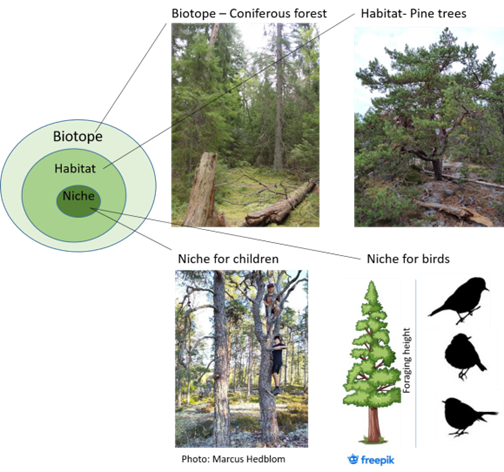
A play biotope refers to concepts in biology, elaborating on “habitat” representing a particular area for a particular type of play, while ‘niche’ could denote the particular activities going inside a habitat. The concept of play biotopes is supportive in the work of creating multifunctional green outdoor areas. We illustrate the play biotope concept by highlighting dead wood as a substrate for conserving beetles and fungi, as well as affordances for children balancing, climbing, or for making huts. We further illustrate the challenges to overcome in practice with a case study revealing the need of a dynamic non-traditional planning process using general sketches, in situ meeting discussing actual solutions, seminars on establishment – plantation -design of nature based play landscapes, and co-creation with children to make play biotopes a reality.
 Relational Thinking