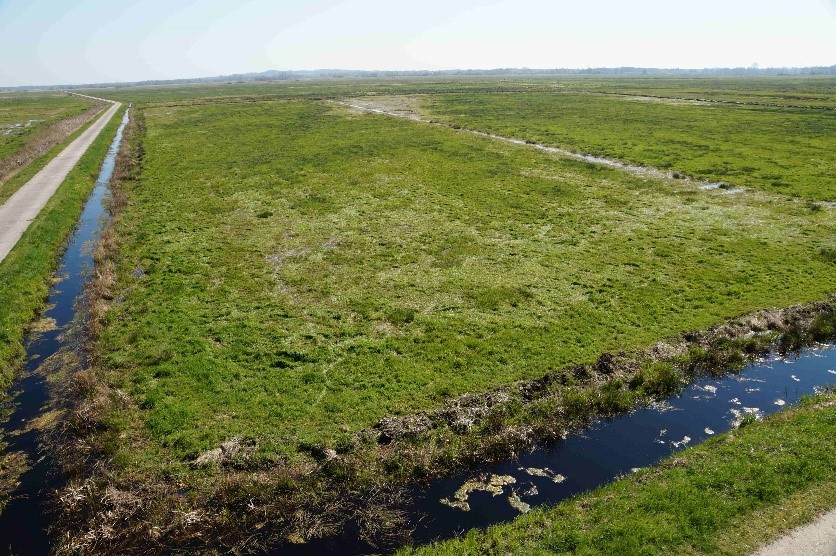
Photo credit: Anke Nordt.
By Amelie Hünnebeck-Wells, Jacqueline Loos, Anke Nordt, and Susanne Abel.
Peatlands store twice as much carbon as the world’s forests. However, through human activity the stored carbon is being released into the atmosphere accelerating global warming. By stopping drainage and rewetting peatlands, these greenhouse gas emissions can be stopped. The collaboration with the individuals living and working in peatland rich regions is essential in order to effectively upscale rewetting efforts across Germany. Rewetting peatlands is however met with resistance in many farming communities. In order to explore the perceptions of individuals impacted by such a change in land-use, our study interviewed 19 peatland farmers in the Teufelsmoor, Germany, to hear their perspectives on rewetting peatlands. The interviews showcased a spectrum of different perceptions and decision-making regarding peatlands which we characterised as Pioneers, Sceptics, Pragmatists and Hobby Farmers.
Our results show some of the challenges, and opportunities associated with rewetting as seen from individual peatland farmers. We clustered our results into categories including the operational challenges of rewetting, knowledge and awareness gaps about peatlands, local stakeholder collaboration, and the perception of peatlands and how this influences the identity of an individual. Our study illustrates that peatland farmers are a diverse group, emphasising the need for varied approaches to support an agricultural shift that works together with peatland farmers to address the climate crisis effectively.
 Relational Thinking