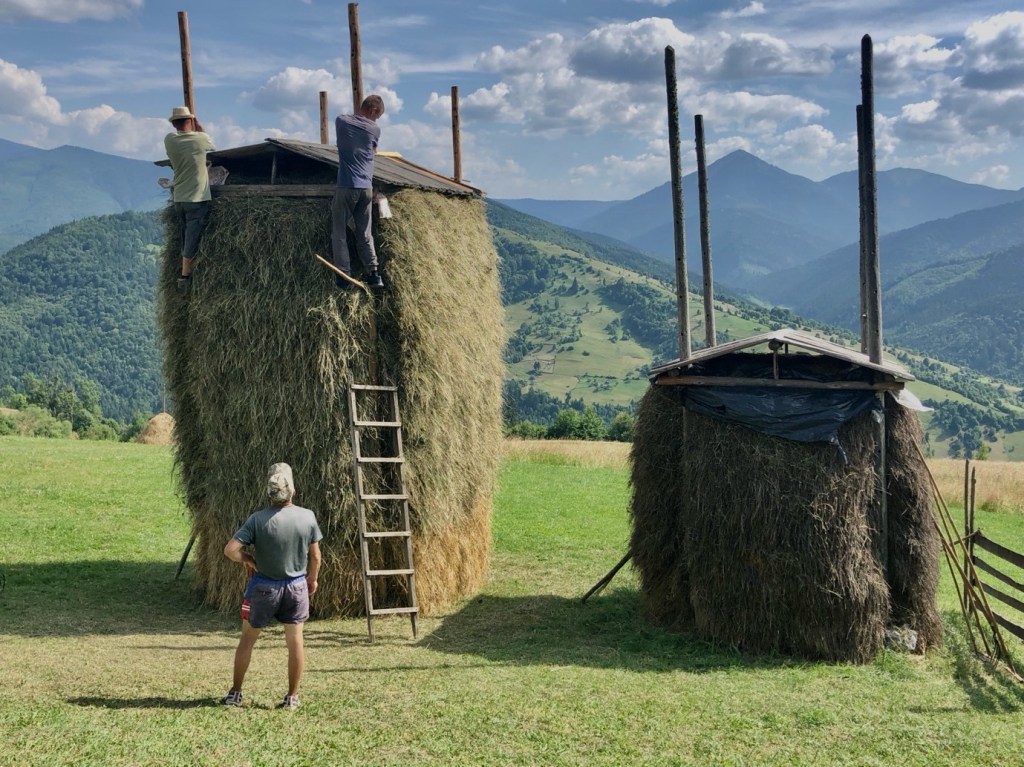
Photographed by Monika Janišová, July 2021.
By Monika Janišová, and Salza Palpurina.
The regions of Maramureș and Bukovina in the Eastern Carpathians remain untouched by modernity, preserving a way of life reminiscent of our ancestors. Here, the hay is as precious as gold, and the bond to the land is unbreakable. These areas boast semi-natural grasslands, including hay meadows and pastures, rich in biodiversity, often referred to as grasslands of high nature value (HNV).
We investigated traditional grassland management practices in these rural landscapes and their associated biodiversity. We explored how these practices have evolved over time and how historical and social factors have shaped the recent diversity of vascular plants and mosses in local grasslands. Our investigation spanned 48 grassland areas in eight villages along the Ukrainian-Romanian borderlands.
We found that traditional farming practices still prevail in most of the grasslands we studied. Land management practices such as the frequency of mowing and the intensity of grazing, rather than environmental factors such as slope or soil composition, mainly influence present-day plant diversity. However, social changes, including declining populations, decreasing numbers of livestock, and changes in agricultural policies, are driving changes in farming practices. One of the most significant changes is the reduced seasonal migration of livestock from the village to mountain summer pastures, the so-called transhumance. Consequently, changes in mowing and grazing schedules are inevitable, significantly impacting grassland plant populations. One of the most interesting findings is that the use of mineral fertilizers in Ukrainian villages during the Soviet era continues to impact plant diversity today.
We propose simple strategies to maintain the remarkable local plant diversity, ensuring that these timeless landscapes continue to thrive.
 Relational Thinking