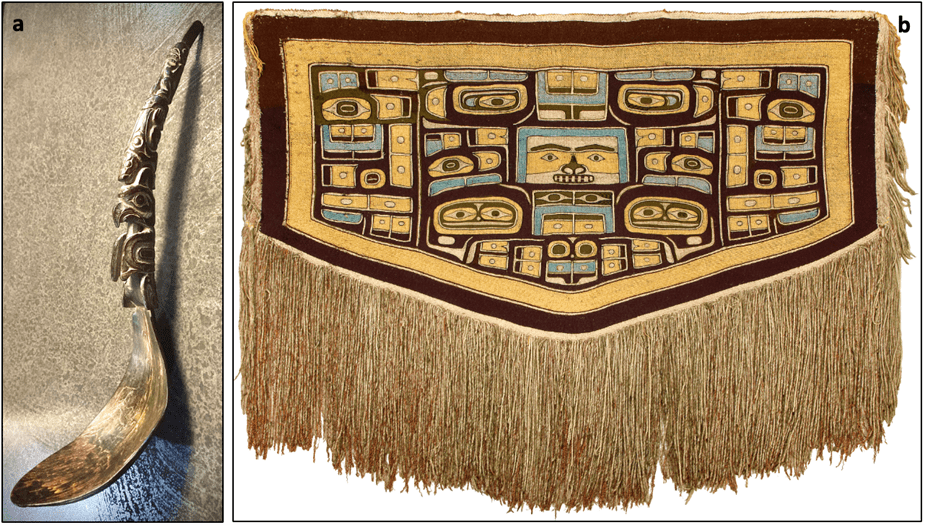
(b) Ts’msyen (Tsimshian) Chilkat robe made of dyed Goat wool and woven cedar bark.
Photo credits:
(a) Taken by author.
(b) Artifact VII-C-2153from the Canadian Museum of History. Used with permission.
By Spencer Greening.
Indigenous peoples’ relationships with ecosystems hold valuable lessons on how humans can relate to – and be stewards in – the natural world. At the core of these lessons is the multifaceted way Indigenous peoples participate within ecosystems. In this paper I introduce Indigenous ecological stewardship through an autobiographical story of being groomed into a mountain goat hunter in my own community – the Gitga’at First Nation of the Pacific Northwest Coast. Through highlighting my learning process with Elders and my relationship with mountain goats and their harvest, this paper creates a conversation on living relationally within an ecosystem one harvests from. The Gitḵ’a’ata (Gitga’at anglicized), have a rich tradition of embedding environmental ethics within harvesting by weaving spirituality, traditional governance, and longstanding dedication to place. I structure this story around a Gitḵ’a’ata philosophy that is rooted in deep-time stewardship, and how in practice, this philosophy creates a triad of becoming, living, and tending the landscape. Under the guidance of my Elders, this takes the form of becoming a traditional mountain goat scholar; living the laws, governance, and harvesting practices; and tending the connection to place through spiritual ceremony and cultural values. I conclude by highlighting how this harvest is a snapshot of one species, and the morals, values, and stewardship practices associated with mountain goats can be just as in depth for many species. In applying the lessons described this paper, it is my hope that readers will be inspired to improve and reflect on their own relationships with the non-human world.
 Relational Thinking