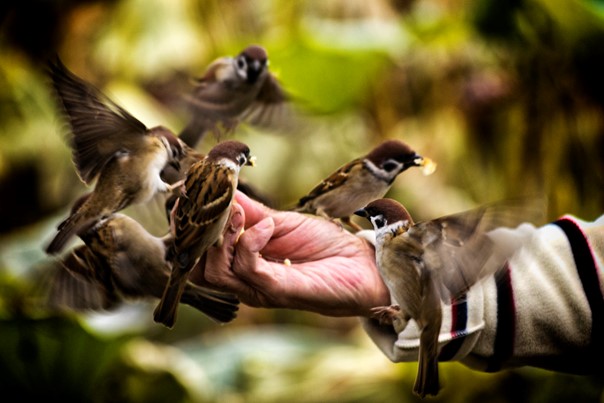
Photo: “Feeding birds” by Diego Cambiaso. Licensed under CC BY-SA 2.0. [Retrieved from Openverse 6-May-24]
By Johan Kjellberg Jensen, Johanna Alkan Olsson, Maria von Post, and Caroline Isaksson.
There is growing concern that people are becoming disconnected from nature. Being disconnected from nature means that you are less likely to care about the environment and spend time outdoors. Since conservation efforts rely on public support and being out in nature is good for your health, it is important to study how we could reconnect to nature. One theory is that experiences with nature during childhood are crucial and that growing up in cities, with little nature around, could be a reason for nature disconnection. Meaningful experiences with nature not only depend on pristine landscapes, however – learning about nature often happens in a social context. It is therefore important to consider the environment and social factors together.
In our study, we investigated the connection to nature of children (age 10-11) from schools in cities and in the countryside, with varying socioeconomic conditions. We used surveys to understand the children’s attitudes to nature, species knowledge, and wellbeing. We then performed a bird feeding project, where the children monitored birds in their schoolyards, to evaluate this wildlife interaction as a possible avenue to reconnect children to nature.
Our results show that socioeconomic factors predict children’s attitudes to nature, regardless of where they live. For example, for both urban and rural areas, high income was connected to participating in nature-oriented activities, which in turn led to positive sentiments towards nature. We did, however, find that the amount of nature close to the children’s homes affected their self-assessed wellbeing: having greenery nearby was associated with feeling better. The bird feeding intervention only impacted species knowledge and children with little nature near their homes learnt the most. The class teachers also appeared to have a pivotal role in the project’s success.
In conclusion, socioeconomics impacts children’s relationship to nature and this is true both in and outside of cities. However, local nature is highly important and so are the adults that guide children in their interactions with nature. Efforts to reconnect children with nature should account for these factors, not the least in identifying which geographic areas to target.
 Relational Thinking