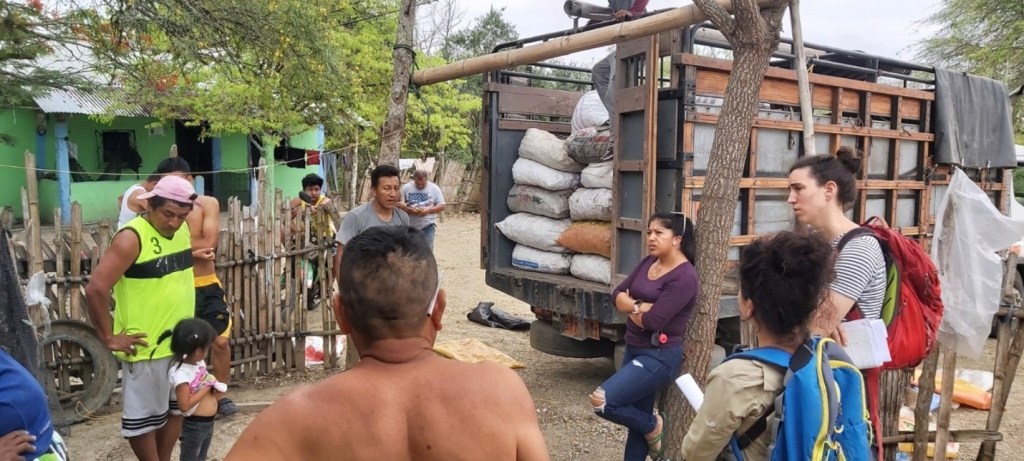
Photo credit: Rommel Montúfar
By Gabriela Loayza, Shirley Pozo, Max Lascano, Anne-Gaël Bilhaut, Anita Krainer, Irene Teixidor-Toneu, and Rommel Montúfar.
Human-plant relationships are beyond the multiple and diverse uses that plants provide (as a source of food, medicine, materials such as wood, fuel, oxygen, atmospheric and humidity regulation, among other services) to encompass institutional and symbolic dimensions. Much is known about the contributions of plants to humans, but humans can also have a positive impact on plant species.
This research uncovers the reciprocal contributions between ivory palm and a commune in Western Ecuador and explores how contributions have changed over time. Our findings show that the inhabitants are the protagonists of countless stories intertwined with the tagua palm. These stories have not been permanent or fixed in time; they have been built through different threads such as socio-ecological agreements, palm management practices, and symbolism, so tagua has proved to be generous with the foragers who have been able to protect, care and multiply it. In return it offers a variety of resources such as food, medicine, handicrafts and raw materials. It has also been part of social cohesion, narratives and all the values that are generated around tagua-human relations. Therefore, the quantity and quality of reciprocal contributions demonstrate that the tagua is an important component of cultural forests, local family economies, and cultural identity. Reciprocal contributions demonstrate that tagua is a cultural keystone species, but socioeconomic changes have a significant influence on these contributions. Although tagua is representative in governance, culture and conservation discourses, it still depends on market pressures.
Our study brings hope that social-ecological systems suffering from overexploitation can tip towards more community-led sustainable use modes through the establishment of new rules and revival of management knowledge and practices, encouraged by public and private organizations.
 Relational Thinking